Wednesday, November 27, 2013

Thanksgiving At The Jade Sphinx


Well, make no mistake about it – 2013 was a difficult year for us here at The Jade Sphinx.  A cluster of calamities sapped our attention, our energy and our peace of mind.  And yet …

Well, if you remember last year’s message, expect the mixture as before.  We here are happy to be alive, delighted in the time spent with those we love, and constantly amazed at the ways in which our lives play out.  I am convinced that those who are negative, or ironic, or simply jaded (a repellant attitude, if ever there was one), are missing a vital fact of life – that while it’s often harrowing, it’s always surprising and definitely worth living.

Though uniquely American, Thanksgiving has always been our holiday least associated with ideology or creed.  It is simply a day set aside to be thankful for the many good things in our lives.  And the celebratory meal represents the bounty that is our lives – the many courses, tastes and phases of a unique and sensual experience.  Though nonreligious, Thanksgiving is sacramental, best shared with people we love.

Thanksgiving has also always been the gateway to the holiday season, and I look forward to this year’s revelries with particular relish.  Christmastime is the best moment to stop and contemplate the quiet miracle of our lives, and that seems more imperative to us this year than ever.  Though we are assaulted daily by cultural and political noise, we continue to find grace notes and things of great beauty that make life meaningful.  I am frankly amazed at some of the magnificent novels I’ve read this year, the pictures that I’ve seen, the music that I’ve heard and the simple human kindnesses I’ve witnessed.  The fine arts provide succor and inspiration, validation and exploration, relief and insight, and the consolations of the arts have been something quite wonderful this year.  But all of this bounty means nothing without human connection.  The arts may enhance and help define these connections, but they can never supplant them.

Happy Thanksgiving – and onward to a warm, rewarding and nurturing holiday season.


Tuesday, November 26, 2013

A Gentleman’s Guide to Love & Murder at the Walter Kerr Theatre


Well, here’s the perfect way to ring in the 2013 holidays: with the first feel-good serial killer musical of the season.  If it seems like an unlikely feat, simply trek to the Walter Kerr Theatre for the silly, sublime, delightful and irresistible A Gentleman’s Guide to Love and Murder.

The show, written by Robert L. Freedman (book and lyrics) and Steven Lutvak (music and lyrics) is, of course, based on the 1907 novel The Autobiography of a Criminal, by Roy Horniman.  This also served as the source inspiration for the classic Alec Guinness film Kind Hearts and Coronets, and since that is one of my favorite comedies, I approached this show with some trepidation.  Could it be nearly as good as the film version?

Well… it’s better.  And for a variety of reasons, not the least of which is that new musical version combines comedy both high and low with snappy period-flavor tunes, a fabulous cast and a sense of sexy irreverence missing from the Guinness film.

Bryce Pinkham stars as Monty Navarro, a handsome and hard up young Victorian gentleman who learns that he is the eighth in line to assume the titles and holdings of the Earl of Highhurst.  He is wonderfully matched by Jefferson Mays, who plays nine characters – eight of whom are murdered by Pinkham in what could only be described as Gilbert & Sullivan Go to Hell.  Freedman and Lutvak provide a showcase for Mays, who portrays a motely array of English (stereo)types, including a gay beekeeper, the expected fox hunter, a buck-toothed prelate, and a do-gooding dowager.  (It is this persona which perhaps best captures the show’s sense of fun.  About to go to darkest Africa to help a struggling tribe, she is sure to pick up the language quickly: Of words they have but six / And five of them are clicks / And all of them are different words for dung.)

Though Mays has the showier part(s), it is Pinkham who carries the show.  Handsome in an impish and insouciant way, he sings beautifully and manages to balance a sense of underhanded menace and boyish charm.  It is a star-making turn.  Fortunately, he is evenly matched by his two love interests, his adulterous lover (Lisa O’Hare) and his fiancée (Lauren Worsham), the sister of one of his murder victims.  The slapstick highlight of the show is when the trio sings I’ve Decided to Marry You, a girl-juggling, door-slamming showstopper that harkens back to Music Hall knockabout comedy.

If the show has a weakness, it is that the tunes are terrific only in context.  Though I enjoyed them immensely, none of them have stayed with me melodically.  There is one high-comic turn between Pinkham and Mays (as the gay beekeeper) with a homo-erotic number called Better With a Man, but other than the fact that it was filled with droll double entendre (it ends as both men hoist a tankard with “bottoms up”), I have no other recollection of it at all.  However, for knockoff Music Hall patter songs, they fit the bill.

Seven of the eight murders take place in the first act, leaving the second act to explore Monty’s love life and eventual downfall.  Like all well-made pieces, characters introduced briefly in Act One return later on with important bits of plot, and even the most off-hand comment or observation provides a payoff.  The show is tight, fiercely funny and precisely played.  Though it is little more than a bauble, I loved it.

A Gentleman’s Guide to Love & Murder is deftly directed by Darko Tresnjak, who has crafted a show alternately arch, brittle, funny and naughty.  Not something easily pulled off.  The set, by Alexander Dodge, is a wonderful embodiment of period theater, and the choreography by Peggy Hickey is smartly staged and flawlessly executed.  (No pun intended.)


A Gentleman’s Guide to Love & Murder is at the Walter Kerr Theater, 219 West 48th Street, Manhattan, 212-239-6200.  If you want to start your holiday season on an irreverent note, you could not do better.

Monday, November 25, 2013

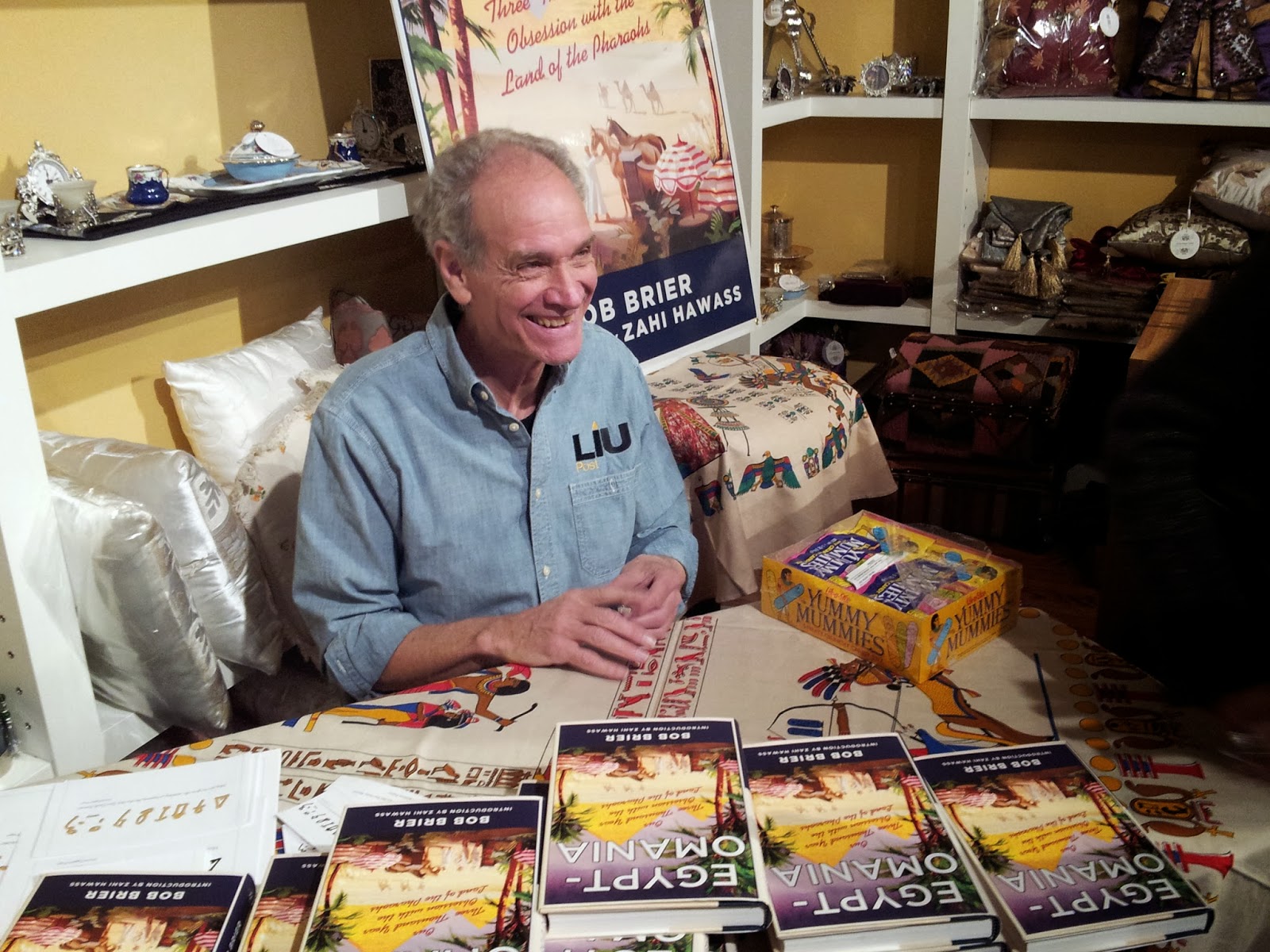
Egyptomania Hits the Dahesh


Yesterday the Dahesh Museum Gift Shop in Hudson Square played host to a capacity crowd for the debut of Bob Brier’s new book, Egyptomania.  Brier is, of course, the celebrated egyptologist who has written eight books, including The Murder of Tutankhamen, and was host of television’s The Great Egyptians and The Mummy Detective

Though an academic with multiple degrees (including actually getting a medical degree to better understand the underlying cause of death of the mummies he has examined), Brier brings to his field of expertise an infectious sense of fun and a true sense of wonder.  Rarely have I laughed so much at a lecture, nor can I remember having been regaled with stories by an expert who is as much entertainer as academic. 

Brier’s book chronicles our three thousand year obsession with the Land of the Pharaohs, and provides a wonderful juxtaposition between the learned (his chronicle of Napoleon’s invasion of Egypt, complete with a retinue of savants to provides what might be history’s first ethnographic study) and the commercial, cataloging “mummy” sheet music, Cleopatra cigarettes and mummy movies featuring everyone from Boris Karloff to Peter Cushing.

Brier argues that no ancient civilization compares to Egypt for its romantic hold on our imagination.  He thinks this is a mixture of our fascination with mummies (here – easily recognizable – are human beings who walked the earth thousands of years ago); the art of Egyptian hieroglyphics; and, of course, what he calls “the Indiana Jones effect.”  Egypt has inspired exotic adventure fiction from pens as diverse as Sir Arthur Conan Doyle, Sax Rohmer and H. Rider Haggard – and this touch of exotica continues in the films of Steven Spielberg and Stephen Sommers.

Your correspondent had the pleasure of interviewing Brier at his home in the Bronx, which is crammed with enough Egyptian artifacts to gladden the heart of Indiana Jones.  That interview, along with a more detailed review of his book, will follow in a few weeks.

In other Dahesh news, the country’s premiere museum-without-walls, has taken the remarkable step of purchasing Frederic, Lord Leighton’s imposing Star of Bethlehem, to expand the scope of the current exhibition, Sacred Visions: Nineteenth-Century Biblical Art from the Dahesh Museum Collection, on view until February 16, 2014 at the Museum of Biblical Art.  Curators and directors from each institution immediately agreed to add the painting to the current installation, as this presented a once-in-a-lifetime opportunity to see the Leighton alongside other like-themed treasures.  The exhibition traces the renewed interest in Biblical myths following the expansion of biblical archeology and the advent of photography, which produced travel books with pictures of the Holy Land.

Curator Alia Nour said last night, “We decided to remove two smaller paintings to make room for this very large one and started to work on a new label. We deemed it worthwhile to give visitors access to one of the most powerful biblical works Leighton produced during the 1860s.”

New Yorkers who have not yet seen the show now have added impetus, and those who have already seen it an added reason to see it once again.  The Museum of Biblical Art is at 1865 Broadway at 61st Street, and admission is free.  For more information, call 212.408.1500.


Friday, November 1, 2013

Twelfth Night, With Mark Rylance and Stephen Fry


Well… talk about a reversal!  As ham-fisted, flat-footed and ill-conceived was the Shakespeare’s Globe production of Richard III, its Twelfth Night is nimble, smart, funny and delightful.  It is, happily, simply the finest Shakespearean comedy that I have seen in decades.  Like its sister production performed on the same set, Twelfth Night strives for Elizabethan authenticity, with period instruments, authentic costumes and males playing female parts. 

Where to begin?  The direction by Tim Carroll is loose and light-on-its feet.  His staging of Richard was lumbering, but here the cast virtually dances through the play.  It never loses it sense of comic pacing, the rhythm and tempo underscoring the moments of farce and comedy both high and low.

Mark Rylance as Olivia – suddenly love-struck after mourning the death of her father and brother  – is a marvel.  All of the fusty business of his Richard is gone, and his natural gifts as a comedian shine.  In his skillful playing, he manages to convey both the tragedy of mourning and the giddy realization of both affection and sexual passion.  Olivia always straddles a difficult line: we are sympathetic to her love for Cesario (who is actually a woman, Viola, in disguise) but tickled at her transformation and seductive quest.  Rylance makes Olivia a profoundly moving comic figure.

Equally moving is the magisterial Stephen Fry as Malvolio.  This is Fry’s first Broadway appearance, and it would be difficult to think of a more challenging role for his debut.  Malvolio – a figure of steady courtesy, sobriety and decorum – is duped by the play’s comic figures into playing the lover to Olivia.  He is thrown into a sunless dungeon for this effrontery and Fry wonderfully embodies the straight-arrow, the foolish wooer and the injured party.  Like Olivia, it is an extremely tricky role – Twelfth Night is not Malvolio’s play, but his presence often resounds with the greatest resonance.  Fry carries both Malvolio’s gravitas and folly on his sizable shoulders in a performance that is not to be missed.

Equally excellent is Samuel Barnett as Viola/Cesario.  The heavy pancake makeup he wears in Richard III, strangely, works surprisingly well in a comedic setting.  Twelfth Night capitalizes on his amazing resemblance in makeup to Joseph Timms (as twin-brother Sebastian) to create an astounding end-of-play revelation.  This resemblance was a misstep in Richard III – but here, the payoff is nothing short of magical.

Equally deserving praise is Paul Chahidi as Maria – who is equal measures comic figure and villain.  He skillfully got laughs without ever losing sight of Maria’s inherent venom.  And Angus Wright, so windy and flat as Buckingham Richard III, delivers a deft comic performance as Sir Andrew Aguecheek – and his near-duel with Cesairo/Viola is a riotous comic set piece.

Finally, special mention must be made of the beautifully spoken and sung performance of Peter Hamilton Dyer as the fool, Feste.  In a play of fools, it is a typical Shakespearean irony that the sanest, and perhaps sweetest, man wears motley.  His singing of the final song is deeply moving, and a fitting finale to the evening.

And moving is perhaps the note upon which to end.  Twelfth Night has always been, at least to your correspondent, a difficult play.  The overwhelming action of the plot revolves around various practical jokes, many of them committed with malice deep and damaging.  Because of the impersonation of Viola/Cesario and thanks to the japes and wheezes of Maria, Aguecheek and Sir Toby Belch, one man is imprisoned to the point of nearly losing his sanity, two men come perilously close to killing each other in a duel, and a lonely woman becomes a figure of fun by falling in love with another woman disguised as a man.  We laugh at all of this, but I found myself saddened, as well.  Olivia’s love for Cesario (at one point, she grabs a halberd in his defense) is no less real for being comic, and Malvolio’s wrongful imprisonment is hard to laugh away. 


Twelfth Night is the last day of the Christmas holidays – and the festive season is never mentioned in the play.  Perhaps Shakespeare selected the title as an indication of the bitter-sweet quality we often feel at the end of our revels.  Or, perhaps he wished to create a light comedy for those who laugh, and a more subtle, darker farce for those who think.  It can be no mistake that the full title is Twelfth Night – Or What You Will.

Thursday, October 31, 2013

The Casebook of Victor Frankenstein, By Peter Ackroyd


His was the most beautiful corpse I had ever seen.  It seemed that the flush had not left the cheeks, and that the mouth was curved in the semblance of a smile.  There was no expression of sadness or of horror upon the face but, rather, one of sublime resignation.  The body itself was muscular and firmly knit; the phthisis had removed any trace of superfluous fat, and the chest, abdomen and thighs were perfectly formed.  The legs were fine and muscular, the arms most elegantly proportioned.  The hair was full and thick, curling at the back and sides, and I noticed that there was a small scar above the left eyebrow.  That was the only defect I could find.

Well, there’s a dainty dish for Halloween day, served up by novelist Peter Ackroyd (born 1949).  Ackroyd is one of our most celebrated novelists and essayists.  His gathered criticism, The Collection: Journalism, Reviews, Essays, Short Stories, Lectures (2001), reflects a lively and opinionated intelligence; these little gems are among the finest things he’s written.

Ackroyd’s biographies are justly famous, and his monumental Dickens (1990) may be the last word on the subject.  Written in the manner of a Victorian novel, Dickens demonstrates the importance of form matched to content.  He has also produced excellent biographies of Turner (2005), Blake (1995) and Thomas More (1998).

Most of his novels are equally distinguished, especially to this reader The Last Testament of Oscar Wilde (1983) and our subject today, The Casebook of Victor Frankenstein (2008).  Readers expecting the usual hugger-mugger of less accomplished supernatural novelists, turn elsewhere.  But … if you are interested in a novel of ideas that is equal parts chiller and historical novel, then this book is for you.

The Casebook of Victor Frankenstein is a wonderful mix of fact and fancy.  Ackroyd’s conceit is that Victor Frankenstein himself was a friend of Percy and Mary Shelley, and was there for that storm-driven evening in Switzerland when the Shelleys, Lord Byron and Dr. John Polidori sat around, telling ghost stories.  That evening led Mary, then 18 years old, to later write the novel Frankenstein (1818).

The novel includes a great deal of actual historical incident (Shelley sent down from school, the drowning death of his first wife, Byron’s friendship with Polidori), while skillfully inserting into it the story of Frankenstein and his monster.  But, more than anything, what Ackroyd is playing with is the Romantic novel of ideas, and the notion that Olympian notions of transcendence and heightened sensibility can be very dangerous things.  Frankenstein – himself neither poet nor artist and, perhaps, an indifferent scientist – dreams of lofty achievement and elevated sensations.  Does that drive him to commit horrible acts … or, worse yet, to create life in a mad ambition to usurp the powers of God, and then refuse responsibility for the life he has created?

More importantly, does Frankenstein’s Monster truly exist, or is it an extension of his own fears, evil ambitions, or, perhaps, a suppressed homosexual desire for Percy Shelley?

Like Dracula, the “meaning” of the Frankenstein Monster has altered with each decade since first created by Mary Shelley – the book can be interpreted as everything from a female-free reproductive paradigm to a socialist tract.  If succeeding generations have grappled with the overarching meaning of the Monster, why should Victor Frankenstein himself be exempt?

Ackroy’ds Monster – like that of Mary Shelley – is no mute, shambling zombie, but, rather, an articulate and vengeful revenant.  He did not ask to be brought into this world and, cannot understand human cruelty and apathy.  Eventually, like Milton’s Satan, he believes that it is perhaps better to do evil than to do nothing at all.  That, perhaps more than anything else, is the true meaning of Halloween.

Here’s another snippet, where the Monster confronts Frankenstein after murdering Shelley’s first wife, Harriet:

“I wished you to notice me.”

“What?”

“I wished you to think of me.  To consider my plight.”

“By killing Harriet?”

“I knew then that you would not be able to throw me off.  To disdain me.”

“Have you no conscience?”

“I have heard the word.”  He smiled, or what I took to be a smile passed across his face.  “I have heard many words for which I do not feel the sentiment here.”  He tapped his breast.  “But you understand that, do you not, sir?”

“I cannot understand anything so devoid of principle, so utterly malicious.”

“Oh, surely you have some inkling?  I am hardly unknown to you.”  I realized then that that his was the voice of youth – of the youth he had once been – and that a cause of horror lay in the disparity between the mellifluous expression and the distorted appearance of the creature.  “You have not lost your memory, I trust?”

“I wish to God I had.”

“God?  That is another word I have heard. Are you my God?”

I must have given an expression of disdain, or disgust, because he gave out a howl of anguish in a manner very different from the way he had conversed.  With one sudden movement he picked up the great oaken table, lying damaged upon the floor, and set it upright.  “You will remember this.  This was my cradle, was it not?  Here was I rocked.  Or will you pretend that the river gave me birth?”  He took a step towards me.  “You were the first thing that I saw upon this earth.  Is it any wonder that your form is more real to me than that of any other living creature?”

I turned away, in disgust at myself for having created this being.  But he misunderstood my movement.  He sprang in front of me, with a celerity unparalleled.  “You cannot leave me.  You cannot shut out my words, however distasteful they may be to you.  Were you covered by oceans, or buried in mountains, you would still hear me.”


We hear him still, nearly 200 years after his conception.  Frankenstein’s Monster is that which in each of us is both abject and terrible.

Wednesday, October 30, 2013

Richard III, With Mark Rylance


It’s not often the Shakespeare’s Globe productions make it to the US, so when they arrive it is cause for riotous celebration.  So … it is with a great deal of disappointment that I report that the recent production of Shakespeare’s Richard III at the Belasco Theatre starring Mark Rylance (born 1960) is an ill-conceived, ramshackle conception.  This is a great shame as Rylance is one of the most gifted actors of his generation – however, I doubt I have ever seen a more wrong-headed interpretation of Shakespeare’s crookbacked anti-hero.

Problems with Richard III start at the top and the rot continues down.  As written, Richard is a charming monster.  He revels in his villainy, and his constant asides to the audience make us complicit in his monstrosity.  His ego is enormous and his self-satisfaction over the most wretched and heinous crimes become droll in his endless self-regard and delight in manipulation.  In short, it is a role for an actor with a High Comic sensibility.

Sadly, High Comedy is not in Rylance’s bag of tricks.  He is an expert Low Comedian, and while he does get laughs with Richard, the overall conception never comes alive.  Imagine Peter Sellers’ Inspector Clouseau disguised as Richard III, and you get the idea.  There is a great deal of business between Rylance and the audience in the first few rows, where he is mugging for a response, while some of his most malefic lines are thrown away as under-the-breath asides.  This is not High Comic villainy, it’s a homicidal Nigel Bruce.  It is a novel approach, but that is all.

Richard III is presented in repertory with Twelfth Night, and in strives to recreate an Elizabethan theatrical experience.  True to the time, all women’s roles are played by men.  I have seen this work wonderfully well in the past (I recall the troupe Cheek By Jowl in a series of Shakespearean productions at BAM 20 years ago that were stunning), but the effect here is more Monty Python than Renaissance theater.  Joseph Timms, as Lady Anne, is so heavily made up that he seems more like a waxwork figure.  (White pancake makeup applied with a trowel, one would assume, to ape portraits of Elizabeth.) Sad to say that equally dire is Samuel Barnett, as Queen Elizabeth, who unfortunately resembles Timms in makeup to such a degree that it’s almost impossible to tell one from the other.

Richard the III is really Richard’s play, and there aren’t many other good roles; however, what is here is poorly played.  Angus Wright, as Buckingham, looks and sounds like Raymond Massey … and is just as bad an actor.  But perhaps the most egregious offender of the evening is Kurt Egyiawan as the Duchess of York, and later as Richmond -- in a lifetime of watching Shakespeare on stage, I have never seen a more wretched performance.  Only Liam Brennan, as Clarence, seems to make something of his part.  I hope to see more of him in the future.

Tim Carroll directs and makes rather a hash of it.  The staging is unimaginative and, at times, simply ridiculous.  Troubled by dreams of his victims, Carroll parades them backstage in white sheets holding candles; more Our Gang than Halloween horror.  How such a gruesome play was rendered so bloodless may be the great mystery of this production.  It ends with Richard and Richmond locked in mortal combat – but it never convinces.  Nor does it help that – in an attempt to create a true Elizabethan experience – the entire cast gather onstage at curtain’s fall and pad through a clumsy quadrille.

We are seeing Twelfth Night later this week; it is Stephen Fry’s Broadway debut, and perhaps his intelligence, taste and sense of fun will positively impact on the production.  We can but hope.


Tuesday, October 29, 2013

Garrick Ohlsson at People’s Symphony


Last week we told you about People’s Symphony Concerts – which have been in existence since 1900, when they were founded by conductor Franz Arens.  World class musicians – both emerging talents and old masters – have been the mainstay of People’s Symphony, and each and every year the lineup grows more impressive.

So, I was greatly excited when an amateur musician friend told me of a concert he heard in San Francisco where Garrick Ohlsson (born 1948) played.  That same concert was in the offering at People’s Symphony and the early verdict was … it was not to be missed.

Nor did Ohlsson disappoint.  The concert at Washington Irving in Gramercy Park last Saturday evening was simply splendid.  Dressed in impeccable tie and tails, Ohlsson is showman enough to command the stage in any venue, and once he sat behind the Steinway piano, he held the audience spellbound for more than two hours.

Ohlsson opened with the very familiar Two Rhapsodies, Op. 79 (1879) by Johannes Brahms (1833-1897).  This warhorse is a mainstay of classical music stations, and one would expect its allure to dim with over-familiarity.  Not so under Ohlsson’s skillful playing; it was fresh and alive and the line of Brahms’ music clean and clear.

Ohlsson followed with Fantasia on Ad Nos, ad salutarem undam, S. 259 (1850) by Franz Liszt (1811-1886), easily my favorite piece of the evening.  This is Liszt at his most ornate and outlandish, and Ohlsson played the Adagio with tremendous gusto and the Fuga with deep sensitivity.  If you are not an aficionado of Liszt or his music, this piece may well change your mind.  It demands quite technical virtuosity, and Ohlsson plays it with brio.

The program continued with Selection from Etude for Piano (1915) by Claude Debussy (1862-1918), which I found amusing, but undemanding.  Debussy has never been wholly to our taste, but the Pour les sixtes was quite wonderful and almost enough to make me reconsider my opinion on this polarizing composer.

Ohlsson ended with Fantasy in F minor, Op. 49 (1841), by Frederic Chopin (1810-1849).  It is a work of deep, emotional tenderness, and it was beautifully rendered by the pianist.

Garrick Ohlsson has a worldwide reputation for his Olympian interpretive and technical prowess.  He was born in White Plains, NY, and began his piano studies at age 8.  He has won too many awards to be fully chronicled here, but they include the Chopin Competition in Warsaw and the Avery Fisher Prize.  His 2013-14 season will include recitals in Montreal, Philadelphia, San Francisco, Los Angles, Seattle and Kansas City, culminating in February at Carnegie Hall.  In January, with the Boston Symphony, he will present the world premier of a concerto commissioned for him from Justin Dello Joio; he will also play, this year, works by Beethoven, Schubert and Charles Tomlinson Griffes.  If you have even the remotest interest in virtuoso piano playing, be sure to see out Garrick Ohlsson this year.


One parting word about People’s Symphony.  There are still some tickets let for their three, concurrent series, but numbers are limited.  It remains the best deal for New Yorkers passionate about music that I have ever come across, and subscriptions will not be regretted.  The can be found at:  http://pscny.org/.

Friday, October 25, 2013

Why I’m a Marxist, Part III: Harpo


Today we look at the most beloved of the Marx Brothers, Harpo Marx.  We must also pause for an unpleasant confession: when we here at The Jade Sphinx first became enamored of the Marx Brothers, we not only disliked Harpo, we loathed him.

Strong words, we know, but let us explain.  While growing up, comedy was for me a verbal exercise – a concentration of wit and wordplay.  Comedy came down to the written word and its skillful delivery.  Comedy was something said.  Slapstick, pantomime and clowning did not possess the elements of wit and intelligence, to our minds, and were simply degraded … funniness.

Fortunately, with age comes wisdom (or a distant relative of it, in my case), and now Harpo is perhaps my favorite of the team.  Not simply because I have been able to overcome my linguistic prejudices and finally recognize his comic genius, but, more importantly, because I see the real and elemental sweetness of the man shining through his work.

Of all of the Brothers Marx, Harpo had much the happiest life.  Groucho said Harpo had a talent for happiness, and that comes through in everything he does.

Harpo was born Adolph Marx in 1888.  He supplemented the family income with piano and harp playing, and joined the act as a comic.  Though he originally spoke in his onstage appearances, reviewers were quick to praise his skills as a pantomime and physical comic.  Knowing a strength when it was pointed out to him, he became a mute act and comedy history was made.

If the Marx Brothers movies are studies in surrealism, then Harpo is the most surreal of them all.  It is no surprise that he was loved by Salvador Dali (1904-1989) and other absurdists.  Like a character from a Looney Tunes cartoon, the rules of time, space and dimension that rule all of us do not seem to apply to Harpo.  He is able to pull lit cigarettes, candles or steaming cups of coffee from the pockets of his pendulous jacket.  Dogs lean out of tattoos and bark at the audience; he can make a payphone payoff a jackpot.  He is virtually indestructible, and though he can be hurt, it seems as if his corporeal self is made of stronger stuff than are we.

But for all of the invincibility – he is the only Marx Brother who is vulnerable.  Harpo is capable of great acts of kindness, self-sacrifice and sweetness that are impossible to the more self-absorbed Groucho and Chico.  In more ways than one, Harpo was the soul of the act – the most outlandish of them all was also the most human.

If Harpo was undisguised ID, it was the ID of a basically good child.  He was ruled by lust, hunger and enthusiasm, but never self-interest, enmity nor malice.  We may wish for Chico’s wiliness, or Groucho’s Olympian wit, but we long for Harpo’s soul.

Harpo married Susan Fleming in 1936.  He was the only one of the performing brothers who married once and married happily.  They adopted four children: Bill, Alex, Jimmy and Minnie.  He is recorded as having told fellow comedian George Burns: I would like to adopt as many children as I have windows in my house.  So when I leave for work, I want a kid in every window waving goodbye.

Though Harpo received very little formal schooling, he was good friends with most of the Algonquin Round Table, including critic Alexander Woolcott (1887-1943), who may have had a homosexual passion for the comic.  Groucho thought spending time with the Round Table was “like swimming in a shark pool,” but Harpo seemed to hold his own, mostly by being such a good audience.  When Woolcott was parodied in the 1939 comedy The Man Who Came Dinner, by George S. Kaufman (1889-1961) and Moss Hart (1904-1961), Harpo was transformed into the character Banjo, memorably played by Jimmy Durante (1893-1980) in the film version.  Harpo and Woolcott, however, both played their fictional selves on the Los Angeles stage – and what your correspondent wouldn’t have given to have seen that!

Later in life, Harpo published his autobiography, Harpo Speaks.  And did he ever, at long last.  His final public appearance was in 1964, when he appeared onstage with comedian Allan Sherman (1924-1973) to announce his retirement.  Once he started talking, it seemed as if he would never shut up.

Harpo died just six months later from a heart attack following open heart surgery.  Many people have recorded that it was the only time they saw brother Groucho cry.

Despite rumors to the contrary, Harpo was not mute and spoke with an old, New York accent.  If it does not destroy too much of the illusion, you can hear him here: 


Watch any of the Marx Brothers films, but especially those from Coconuts (1929) to A Night at the Opera (1935).  It’s enough to make you a Marxist, too.


Harpo With His Real-Life Children

Thursday, October 24, 2013

Why I’m a Marxist Part II: Chico


We continue our look at advanced Marxism with a profile of perhaps the most underrated Marx Brother, Chico Marx.  (For all intents and purposes, we will consider Zeppo, handsomest of the Marxes, as interchangeable leading man.)

Chico is often dismissed as a one-joke character: a zany Italian immigrant accent waiting for a misunderstanding to happen.  That is only true as far as it goes; Chico’s art was much more subtle than one would think.

First, there is the question of Chico’s ethnicity.  Is he represented “as” an Italian, or some mad simulacrum of one?  I, for one, am never sure.  I am reminded of a scene in Animal Crackers (1930), where Chico recognizes a fellow conman in disguise:

Ravelli (Chico):    How is it you got to be Roscoe W. Chandler?
Chandler:             Say, how did you get to be Italian?
Ravelli:                 Never mind—whose confession is this?

Chico has often been dismissed as “the third one,” or, more ridiculously, as Groucho’s straight man.  What both assessments fail to consider is that Chico could be screamingly funny with the right material.  In Duck Soup (1933), Chico is a spy snooping on President Rufus T. Firefly (Groucho).  Here is his report to the foreign ambassador:

Monday we watch Firefly's house, but he no come out. He wasn't home. Tuesday we go to the ball game but he fool us: he no show up. Wednesday he go to the ball game and we fool him. We no show up. Thursday was a double-header; nobody show up. Friday it rained all day. There was no ball game, so we stayed home and we listened to it over the radio.

Chico has his best moment in A Night at the Opera (1935).  There, he, Harpo and the Zeppo stand-in (Allan Jones) are disguised as famous aviators who travel to America … by steamship.  At the reception welcoming our heroes Chico recounts:

Friends, how we happen to come to America is a great story. But I don't tell that... The first time we started, we get-a halfway across when we run out-a gasoline and we gotta go back. Then I take-a twice as much gasoline. This time we-a just about to land. Maybe three feet. When whaddya think? We run out-a gasoline again. And a-back we go again to get-a more gas. This time I take-a plenty gas. Well, we get-a halfway over when what-a you think-a happened? We forgot-a the aeroplane. So we gotta sit down and we talk it over. Then I get a great idea. We no take-a gasoline. We no take-a the aeroplane. We take a steamship! And that, friends, is how we fly across the ocean!

However, it is now time to put down the notion that Chico was Groucho’s straight man once and for all.  Very often the verbal highlight of a Marx Brothers film is the duologue between Groucho and Chico.  What is amazing about these verbal fisticuffs is that…. Chico usually wins.

We have become so accustomed to Groucho being the genuine wit of the group, and that his verbal dexterity was so powerful that mountains would fall before him, but simply watching the films demonstrates that Chico almost always gets the better of Groucho.  And that is because Chico wields his own version of Groucho’s greatest weapon against him:  he is impervious to logic.

These set pieces often start on a very prosaic level and become increasingly more surreal and absurd, often because Chico is either taking everything Groucho says literally, or his own brand of absurdity is more impervious.  Here, for example, is Chico guarding a speakeasy when Groucho comes to the door.  The password to get in is “swordfish,” and Chico lets Groucho have three guesses:

Baravelli:    Who are you?

Wagstaff:   I'm fine thanks, who are you?

Baravelli:    I'm fine too, but you can't come in unless you give the password.

Wagstaff:   Well, what is the password?

Baravelli:    Aw, no! You gotta tell me. Hey, I tell what I do. I give you three guesses. It's the name of a fish.

Wagstaff:   Is it Mary?

Baravelli:    Ha-ha. That's-a no fish.

Wagstaff:   She isn't, well, she drinks like one. Let me see. Is it sturgeon?

Baravelli:    Hey you crazy! Sturgeon, he's a doctor cuts you open when-a you sick. Now I give you one more chance.

Wagstaff:   I got it! Haddock!

Baravelli:    That's-a funny. I gotta haddock, too.

Wagstaff:   What do you take for a haddock?

Baravelli:    Well-a, sometimes I take-a aspirin, sometimes I take-a Calamel.

Wagstaff:   Say, I'd walk a mile for a Calamel.

Baravelli:    You mean chocolate calamel. I like that too, but you no guess it. Hey, what-sa matter, you no understand English? You can't come in here unless you say 'swordfish.' Now I'll give you one more guess.

Wagstaff:   (to himself: Swordfish. Swordfish) I think I got it. Is it 'swordfish'?

Baravelli:    Hah! That's-a it! You guess it!

Wagstaff:   Pretty good, eh?

Chico was the oldest surviving of the Marx children (brother Manfred died in infancy) and the first to pass away.  He was born Leonard Marx in 1887 in New York.  He was, in many ways, the wild Marx.  A gambler and hustler, he never met a card game or a chorus girl he could resist.  And though he was a chronic philanderer, his two wives and daughter doted on him.

Though a disaster as a gambler (eventually his brothers had to take his financial matters in hand themselves … mainly to keep Chico from being killed over gambling debts), he was a wonderful manager and schmoozer.  He managed the act after mother Minnie Marx died, and his connections at MGM got the team out of Paramount and over to Metro, where they made two masterpieces, A Night at the Opera (1935) and A Day at the Races (1937), under the auspices of wunderkind Irving Thalberg (1899-1936).  Between films, Chico toured with a Big Band, The Chico Marx Orchestra, with singer Mel Torme.


The Brothers Marx seem to run true to form onstage and off.  When Chico died in 1961, his funeral was held in the Wee Kirk O’ the Heather Chapel at Forest Lawn Memorial Park.  A rabbi officiated for a Jewish fake Italian in a replica Scottish chapel.  At the funeral, one of the speakers described Chico in terms unrecognizable to both friends and family, prompting Harpo to lean over to his surviving brothers and say, “when I go, do me a favor and hire a mime.”


Wednesday, October 23, 2013

Why I’m a Marxist Part I: Groucho


Okay, I’ll admit it – I’m a Marxist.  I’ve been a Marxist for as long as I can remember, dating back to my earliest years of grade school.  And I don’t see it changing any time soon.  I’m a Marxist for life.  (Note to the NSA: this is an old, venerated American tradition called humor.  Just go with it.)

Hard as it is to believe now, but at one time it was possible to be young in the US and have aesthetic and emotional attachments to cultural artifacts of previous generations.  When I grew up in the 1970s, it was just as easy to be a rabid fan of The Marx Brothers or, say, Bela Lugosi, as it was to appreciate Elton John or The Beatles.  Culture was a more amorphous stew of new and old, good and bad, the tried-and-true and the newly emerging.  Radio dramas from the 1940s could still be heard in reruns on radio along with Top 40 programs, and late night television was awash in classic American cinema.  It was a wonderful time to grow up, if one was awake, because the great kaleidoscope of American culture was spread out before you.

That has largely changed.  Our culture has become too fragmented, our viewing and listening habits too balkanized, and our deep and abiding suspicion of anything remotely challenging has shrunken the offerings of our cultural landscape.  It is, I believe, the sneaking suspicion that something not contemporary may be too challenging -- too slow, too much story, not loud enough – that has consigned so much of American culture, both high and pop, to the contemporary dustbin.

Not so just a few decades ago.  And no figures from the Golden Age of American pop culture loomed larger – in college campuses or grade school playgrounds – than the comedy team The Marx Brothers.  It is arguable that the Marx Brothers were more popular in the 1970s than they were in their heyday of the 1930s.  It is a success story that has no real equal in American entertainment, except, of course, for the continuing popularity of the more proletarian Three Stooges.

During this reclamation, the aging and increasingly frail Groucho Marx (1890-1977) managed a one-man show at New York’s Carnegie Hall, and appeared on just about every television venue that would have him.  It was a wonderful coda to a remarkable career, and one that, we hope, made up for many real-life disappointments and setbacks.

Born Julius Henry Marx in New York, Groucho was pushed into show business by his mother, Minnie.  She was convinced that a family act would be a hit, and all five brothers would eventually work onstage as a team or separately.

Chico, the oldest brother, was a compulsive gambler and womanizer who seemed, oddly enough, to be mother’s favorite.  Things came easily to Chico, and Groucho resented that.  Harpo, who clearly had some kind of undiagnosed learning disability, was often the subject of Groucho’s most condescending jokes.  However, Harpo was a genuinely happy man – he had a talent for happiness that Groucho lacked.  (Indeed, Groucho was deeply suspicious of happiness.)  The two younger brothers, Zeppo and Gummo, never really embraced show business, but Groucho felt a responsibility towards them, and often made arrangements to further their careers and businesses.

In fact, Groucho played father to his brood of brothers, something that their real-life father Sam could never quite pull off.  It is perhaps this early imposition of responsibility and obligation that soured Groucho so early in life, and made his private relationships so fraught.  He married three times, twice to women young enough to be his daughter, and spent his sunset years with a conniving adventuress who sucked away his energy and cash while trying to establish herself as a Hollywood player.

But, whatever messiness of his private life, Groucho was probably the most gifted comedian of the 20th Century.  He had all the gifts: he looked funny, his voice was funny, his walk and mannerisms were funny; he was a gifted physical comedian and a comedic lord of language.

Groucho’s métier was the insult; this has been much degraded of late, but with Groucho it was an art form.  Groucho’s insults relied on real wit, not merely funniness, which is, in the final analysis, the ultimate indication of intelligence.  We could easily fill up multiple pages with examples, but here is one delirious scene from Horse Feathers (1932).  Groucho, as Professor Quincy Adams Wagstaff, romances college widow Connie Bailey (Thelma Todd) in a rowboat while she tries to steal information on the upcoming college football game:

Wagstaff:   This is the first time I've been out in a canoe since I saw The American Tragedy.

Connie:       Oh, you're perfectly safe, Professor, in this boat.

Wagstaff:   I don't know. I was going to get a flat bottom but the girl at the boat house didn't have one.

Connie:       Well you know, Professor, I could go on like this, drifting and dreaming forever. What a day! Spring in the air.

Wagstaff:   Who, me? I should spring in the air and fall in the lake?

Connie:       Oh, Professor, you're full of whimsy.

Wagstaff:   Can you notice it from there? I'm always that way after I eat radishes.

The football team's signals fall out of Wagstaff's coat pocket into the water and drift by Connie. He boasts that he has a second set of signals in his other pocket: Luckily, I've got a duplicate set in my pocket. I always carry two of everything. This is the first time I've only been out with one woman. Then, she attempts to use baby talk on him to divulge Huxley's football signals:

Connie:       Do you know, Professor, I've never seen football signals? Do you think a little girl like me could understand them?

Wagstaff:   I think a little girl like you would understand practically anything.

Connie:       Is gweat big stwong man gonna show liddle icky baby all about the bad footbawl signals?

Wagstaff (startled): Was that you or the duck? 'Cause if it was you, I'm gonna finish this ride with the duck.

Connie:       If icky baby don't learn about the footbawl signals, icky baby gonna cwy.

Wagstaff:   If icky girl keep on tawking that way, big stwong man gonna kick all her teef wight down her thwoat.

The Marx Brothers made some 13 films in all; some brilliant (Duck Soup, Monkey Business, Horse Feathers, A Night at the Opera, A Day at the Races), some awful (At the Circus), but all worth seeing, even if for only occasional glimpses of genius.

In the 1950s, Groucho became a solo act, serving as quiz master for You Bet Your Life on both radio and television.  Here was Groucho in his element – talking to a broad cross-section of people and deploying his killer wit.  Oddly enough, this was Groucho’s most celebrated star turn before his great revival in the 1970s, and though amusing, You Bet Your Life was never as inventive, transgressive or fall-down funny as his classic films.

If you have not seen the early Marx Brothers films – particularly the films made at Paramount: The Coconuts, Animal Crackers, Monkey Business, Horse Feathers and Duck Soup – do so without delay.  They are among the most wonderful artifacts of American pop culture.