Showing posts with label Guardians of Childhood. Show all posts

Wednesday, May 11, 2016

Ollie’s Odyssey by William Joyce


Many artists reach a plateau and stay there, revisiting the same themes or visions, never expanding, never stretching, never evolving with their work.  And then there are those lucky few artists – which includes writers, graphic artists, musicians and performers – who continually grow, develop and stretch their capabilities.

Into that happy few we must count author, illustrator, animator William Joyce (born 1957).  After creating some of the most beautiful picture books of the 1990s, Joyce then branched off into his other love, filmmaking, and helped design a number of memorable films (including Toy Story), before branching out into production himself.  He also started the company Moonbot to make apps, games, animated shorts – anything, in fact, to which he could harness his storytelling genius.  Located in Louisiana, Moonbot is a human-scale Disney, where talented artists, writers and filmmakers create the next generation of children’s classics.

His first love, though, remains books.  He started a series of picture books and prose novels that detailed the origins of such childhood myths as Santa Claus and the Easter Bunny called The Guardians of Childhood, and he has now served up a new original novel with illustrations, Ollie’s Odyssey.  It is his most daring and interesting prose novel to date, and a significant demonstration of his ever-increasing capabilities.

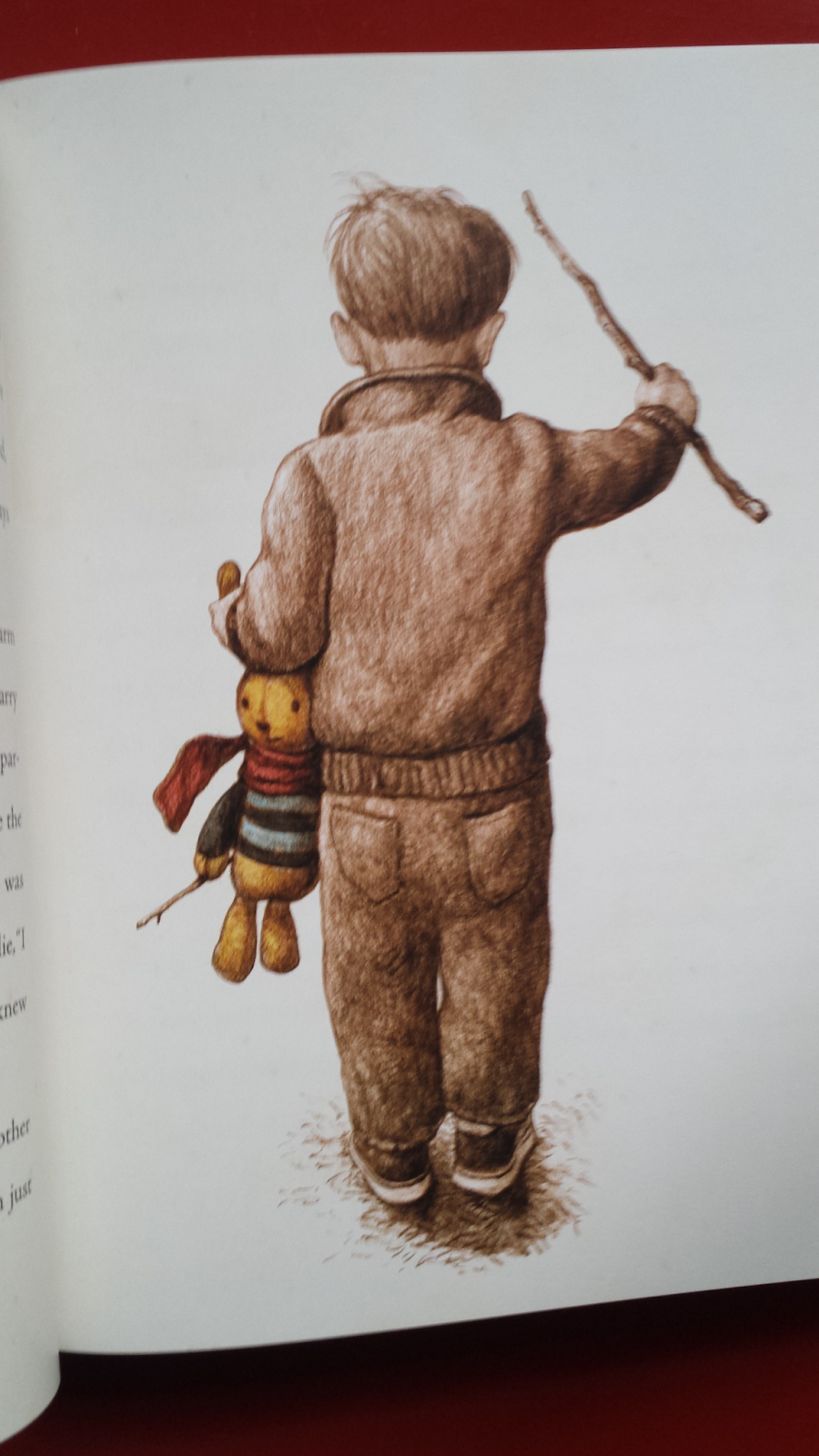
Ollie’s Odyssey is all about a kid named Billy and his special relationship with his toy, a ragdoll his mother made named Ollie.  During a wedding party, Ollie is kidnapped by the minions of an evil toy, the demented clown Zozo.  Billy must sneak out of his home at night and trace his lost friend, a journey that leads him to a deserted underground carnival, to a confrontation with a horde of menacing reconfigured toys, and to a final battle royale led by Ollie and some odds and ends who form a junk army.

In outline, it would seem as if Ollie’s Odyssey would be just another kid’s adventure story.  But Joyce uses this framework to write a deeply moving tale about growing up, the inevitability of change, loss and, perhaps most important, the power of memory.  Rather than a stock villain, Zozo has become twisted through the loss of his beloved ballet dancer-doll.  He is a tragic-villain, fully formed and compelling enough for the most adult fiction.  Similarly, Billy and Ollie fear changes to their friendship as Billy ages, and Ollie wonders what becomes of toys that are no longer loved.  The coming end for their partnership does not mitigate in any way the love they have for one another, but it does add a tragic dimension unusual for kiddie fare.  Joyce also talks about resurrection and rebirth during the junkyard sequence, where now useless bric-a-brac takes on new life and new identity to help Ollie and save Billy.  It is a stunning juggling act: Joyce has written a profoundly moving and emotionally resonant novel in the guise of a children’s book.

Just as Joyce has previously illustrated his picture books with dazzling watercolor work, and then branched out into both line drawings and computer illustration, Ollie’s Odyssey tests his versatility with a series of charcoal drawings – a medium he has not used in his published work before.  The illustrations of Ollie’s Odyssey are unlike those of any of Joyce’s previous work, and fit the overall emotional tenor of the story beautifully.  Charcoal brings a gritty, tactile sense to this tale of fuzzy friends and frayed castoffs that would be missing from glossier modes of illustration.  He also used the paper upon which he drew to great effect, allowing what would normally be the white ‘tooth’ of the paper to soak up computer-added color.  The book is also beautifully designed by Joyce with chapter heads in bold red crayon, and different colored papers representative of different characters and scenes. 

As with much of Joyce’s oeuvre, his latest book can be savored by adults as well as children. A man who loves popular art immoderately (and wears that love on his sleeve), Joyce peppers Ollie’s Odyssey with echoes of titans and works that come before.   Attuned readers will catch bits of filmmakers Todd Browning and Lon Chaney, hints of the classic Universal Monsters with a touch of The Island of Lost Souls, a healthy smattering of Ray Bradbury, and shout-outs to everything from the original King Kong to Batman Returns to The Magnificent Seven.  Indeed, the final image of the book is a direct rift on John Ford’s mighty ending for The Searchers … and one wonders if Joyce is writing for adults who have kept their inner child alive and well, or if he writes for children who will one day make more adult connections.

Ollie’s Odyssey is a bigger, grander, more ambitious book than anything that Joyce has attempted before, and he rises to the occasion splendidly.  It is certainly the finest of his prose novels, and one cannot but wonder what this protean talent has in store for us in future years.

While we are delighted that Joyce has spread his abilities into so many different areas, it is perhaps in books that devotees get the fullest distillation of his talents.  His written and illustrated works are the least collaborative of his output, and capture his philosophy best.  That view of life has been changing and evolving over time – that William Joyce names his protagonist Billy is surely no accident – and if the man himself can emerge from the crucible of experience with his sense of wonder intact, what is he not capable of?  And what, he asks, are any of us not capable of?  It’s that sense of possibility, that childlike sense of limitless adventure, that the world is filled with things to delight each and every one of us, that is the essence of Bill Joyce.


Ollie’s Odyssey is highly recommended to kids, old people, and everyone in between.


Tuesday, April 12, 2016

William Joyce Wants Your Toys!


We have frequently looked at the work of illustrator/film-maker William Joyce (born 1957) in these pages.  He is one of the most gifted creators in the field of children’s entertainment today; his books have won numerous awards, one of his animated films has won an Oscar, he created his own wonderland-cum-story-telling-factory Moonbot, and most important, he was won a place in the hearts of everyone who takes expertly crafted, intelligent family entertainment seriously.  Joyce has shared his peculiar magic with the world, and now he wants something in return … your toys.

Recently, Joyce has been thinking about toys while preparing his upcoming book, Ollie’s Odyssey (soon to be reviewed in these pages).  In particular, he has been thinking about Big Teddy, a huge stuffed bear owned by his late daughter, Mary Katherine, as well as his own bear who became lost when we has around six years old.  What happened, he wondered, when beloved toys became separated from the people who loved them?

Right now, Joyce is collecting stories of beloved toys and their people on his Twitter account.  Tweet him at @heybilljoyce with a photo or drawing of your most beloved toy.  Every week, Joyce will pick one to illustrate and post, and then he will mail the drawing to you!


This is a wonderful opportunity to share an important part of our childhood with a man who has done so much for children’s literature, and who has brought a significant amount of wonder into the lives of children and adults.  Make your day a little happier and check out Bill Joyce on Twitter.

Tuesday, December 1, 2015

Christmas Books: Jack Frost by William Joyce


Readers of The Jade Sphinx are well aware of our high regard for well-crafted children’s literature.  The genre boasts works that demonstrate all of the best that was said and thought in the language – think Wind in the Willows, Peter Pan or The House at Pooh-Corner – and has carved out a singular literary tradition of its own.  The United Kingdom and Continental Europe owns this literary franchise (from the days of Grimm’s Fairy Tales to today’s own Harry Potter), and any serious discussion of the genre returns again and again to several key, European works.

Fortunately for us here in the United States, we have enjoyed our own golden age – but the tradition stateside has really been in fabulously-illustrated picture books.  Our great prose fantasist was L. Frank Baum (1856-1919), but most American masters have a special magic for merging word with image, and they have created art of a very high order.  For the last 50 years or so, the US has been home to some of the most fertile, creative and artistic book creators in the world. 

The fullest contemporary realization of this great tradition is the Louisiana-born William Joyce (born 1957).  We have been watching his work with great interest, and he has not lost his ability to continually surprise us.

After decades of beautiful and evocative work, Joyce has concentrated on his magnum opus, The Guardians of Childhood series, which chronicles the beginnings of such childhood gods as Santa Claus, the Easter Bunny, the Tooth Fairy and the Sandman.  The series has included both prose novels and picture books, and unified his own cosmology, much like Baum’s world-building Oz books.  The latest installment in the series is the lavishly illustrated picture book, Jack Frost, created in collaboration with Andrew Theophilopoulos.

As his narrative has crossed several mediums (prose novels, picture books and a feature film), Joyce has had to juggle elements between episodes to maintain a fully-realized whole.  Jack Frost provides the bridge between the character Nightlight as seen in the books and Jack Frost, who served as the focal character of the feature film.  But as a key segment in the ongoing narrative, or as a stand-alone picture book, Jack Frost is terrific entertainment and a delightful addition of the Guardians saga.

In short, Frost tells how the heroic sprite Nightlight sacrifices his life to protect the infant Man in the Moon from the soul-crushing evil of the series villain, Pitch.  (That’s the Boogeyman to me and you.)  Nightlight saves the day, but at terrific cost.  He resurrects as Jack Frost, but has no memory of his former self or mission.

What follows is some of the most haunting and resonant themes in the Joycean canon – that of death and resurrection as well as continual change and growth.  Frost feels Olympian isolation and loneliness, and as he does, he leaves cold and frost in his wake.  This winter of the soul becomes actual winter weather for humankind – until that grief and mourning can be rechanneled into healthier, more positive energy.

Joyce accomplishes this miracle with great economy of language; he has also retained the lush blue-gold European palette of the series, paying homage to the Continental roots of many the of Guardians.

The series will continue with additional prose novels and picture books, and one wonders how Joyce will conclude his epic in the books to come.  There is the sense that the Guardians of Childhood is a mid-career summation of Joyce’s artistry, of his deepest-held beliefs, and his untiring optimism and energy. The Guardians of Childhood is a magnificent monument to a kind and benevolent genius, and an important influence on young hearts and imaginations.  More, please.


Jack Frost is available in bookstores everywhere, and is highly recommended for the young (and young at heart) this holiday season.


Wednesday, October 29, 2014

A Bean, A Stalk and a Boy Named Jack, by William Joyce


Proving that once again the ridiculous is often sublime, author-illustrator-film-maker William Joyce returns with a new book for young readers, A Bean, A Stalk and a Boy Named Jack.  This is Joyce’s amusing and endearing take on the Jack and the Beanstalk fairy tale … and perhaps another story or two, thrown in.

Joyce provides the narrative this time, allowing newcomer Kenny Callicutt to provide the illustrations.  The text is Joyce as his breezy, irreverent best.  There’s a drought in the kingdom where small boy Jack lives, resulting in a severe problem: the monarch’s pinky is now stinky.  It’s up to a small boy, an even smaller bean, and a very large stalk to travel upwards to a land of giants (including a rather endearing young giant in his bath), and make the world right once more.  Delivered in a sort of staccato, wise-guy meter, A Bean, A Stalk and a Boy Named Jack is tons of fun for the younger children of all ages.

A special word here about illustrator Callicutt: though his style is similar to Joyce, it is completely his own.  The figures have a wonderful, toy-like quality (as if Mother Goose created a line of Lego toys), and are drawn with a pastel-toned minimalism.  Callicutt first came to Moonbot, Joyce’s company, as an apprentice, and this is his first picture book.  We hope it’s the first of many.

Moonbot, of course, is Joyce’s imaginarium located in Shreveport, Louisiana.  After years as the most creative and light-hearted children’s’ book double-threat in the industry, Joyce created Moonbot Studios to nurture new talents and create extraordinary entertainment for an array of media platforms. Moonbot makes not only books, but apps, games and anything else that is a medium to carry narrative.  If you think that Joyce has created a small-scale Disney down-south, you would be right – but one more nimble, daring, irreverent and, most of all, directly connected to its legion of fans.  Expect great things from Moonbot in the years to come.

Like much of the Joycean oeuvre, it would seem that A Bean, A Stalk and a Boy Named Jack is tied into a larger, mythic universe.  Jack holds a staff much like Jack Frost from Joyce’s Guardians of Childhood series – are they the same person?  The Princess (and we must always have a Princess) is named Jill … are there possibilities there?  And will this book open up an entire series of Joyce’s fractured fairly tales?  We can only wait and see.

On top of the language-play and delightful visuals, it is always a pleasure for your correspondent to welcome the annual offering from William Joyce.  It is an indication that the holiday season is upon us, and that things will always turn out right in the end.

Even if your pinky is stinky.


Thursday, December 19, 2013

Who Is Your Santa, Part III: The Santa Claus of William Joyce


Today, we actually get two Santa Clauses for a single entry as we look at the work of William Joyce (born 1957).

Joyce took the publishing world by storm in the late 1980s-early 1990s with a series of picture books, including Dinosaur Bob (1988), A Day With Wilbur Robinson (1990), and his Christmas book, Santa Calls (1993).

Though Joyce has expanded his talents into film and television production, it is his picture books that I perhaps love the best, and Santa Calls most of all.  It tells the story of Arthur Atchinson Aimesworth, boy inventor, cowboy and amateur adventurer.  With his sidekick, Spaulding Littlefeets, and his sister, Esther, he goes from Abilene, Texas to Santa’s Toyland at the North Pole.  There, Esther is kidnapped by the Dark Queen and her evil elves, and it is up to Art, Santa and the rest of the gang to rescue her.

In summary, it does not sound like much – but in execution, it is nothing short of magnificent.  I have long considered Santa Calls to be Joyce’s masterpiece, and it is a story that I seem to see with fresh eyes every year.

First off, Joyce’s talents as an illustrator were never put to better effect.  The entire book is suffused with a creamy, subtle color strongly reminiscent of the Golden Age of Illustration.  (Without a publication date, anyone coming to the book with fresh eyes could easily mistake it as a work from the 1930s or 1940s.)  True to his art deco aesthetic, Joyce reimagines Santa as a North Pole dandy, complete with flowing red frock coat (trimmed with white), striped off-white vest and dashing monocle.  And his Toyland is filled with gadgets both wondrous and fabulous.  This should not be surprising – as one of Joyce’s inspirations was… James Bond.  Joyce conceived of Santa as an older gadgeteer, and his workshop much like the highly-mechanized fortresses found in the Bond films.  Double-Ho Seven, indeed.


His Toyland – where the motto is The Best of the Old, The Best of the New, The Best That Is Yet To Be – is a major feat of imagination.  Inspired by both the spacious and ornate dreamlands found in Winsor McCay’s Little Nemo strips, it also nods its head at the Emerald City of Oz.  However, with its floodlights, bow-tied elephants, Santa-shaped buildings and walking beds… it rather makes the Emerald City look like Dubuque.

The action zips along as quickly as a Robin Hood adventure, and is richly garnished with Joycean pop culture references to everything from Punjab in Little Orphan Annie to silent screen cowboy Tom Mix to the pets found in Doc Savage.  But through it all beats a warm and generous heart, and I guarantee that this overstuffed and gorgeously designed book will leave you weepy at the final revelation.  It is my favorite Christmas picture book.

Joyce has revisited Santa in his overarching cosmology – the Guardians of Childhood.  This is his effort to tell the origin story of such childhood touchstones as Santa Claus, the Easter Bunny and the Tooth Fairy, among others.  Here, Santa is a reformed Cossack bandit, who learns magic and compassion from the wizard, Ombric.  Though the series is not yet complete, we see some of what Santa will become – in the latest installment, he has already started construction of his Toyland.  This Santa is a dashing, reformed brigand.  He has a sense of style and the dramatic, and is more an adventurer at this point of the series than anything else.  Armed with swords or a robotic genie, this Santa is ready for all comers in his efforts to protect his band of Guardians, and we see the nurturing, patriarchal side of the man emerge.  It is an interesting transformation, and we wonder how Joyce will end the series.

In the film version released last year, Rise of the Guardians, Santa was voiced by Alec Baldwin, in what has to be the voice performance of the decade.  It is perfect holiday fare, and as Christmas approaches, you could not do better than spending it with the Guardians of Childhood.

One Last Santa Tomorrow!


Tuesday, December 3, 2013

Sandman and the War of Dreams, by William Joyce


Regular readers of The Jade Sphinx know that we take our Christmas here very, very seriously, so it is with great delight that we announce that prolific author, illustrator, animator and filmmaker William Jocye (born 1957) has released the next prose novel in his ongoing Guardians of Childhood series, Sandman and the War of Dreams.  It is, in a word, marvelous.

For those of you who came in late: Joyce has undertaken to create a series of books – both picture books and prose novels – that chronicle the origins of the great heroes of childhood, including Santa Claus, the Easter Bunny, the Tooth Fairy, the Man in the Moon, and the Sandman.  In doing this, he does not fall into the trap of presenting the mixture as before, but, rather, creates a whole new persona and background for each classic figure, making it wholly his own.  (Did you know that the Easter Bunny is the last of a race of brilliant warrior rabbits?  Or that Santa Claus was raised by Cossack brigands?  If not, read on….)

Brazenly, Joyce ends his novels with edge-of-your-seat cliffhangers.  In the last book, Toothiana Queen of the Tooth Fairy Armies, the heroine, Katherine, was kidnapped by Pitch (the Bogeyman) and his daughter, the beautiful and dangerous Mother Nature.  Our heroes return to the magical land of Santoff Clausen to regroup, convinced that Katherine may be lost to them forever.  However, just when things look their darkest, out of the night (literally) comes the newest Guardian to join their ranks, the Sandman.

Or, to be more precise, Sanderson Mansnoozie.  Awakening from a sleep of eons, Mansnoozie is one of the last of a great race of star-faring Star Captains.  Or, as Mansnoozie explains, As a star pilot, I belonged to the League of Star Captains, a cheerful brotherhood devoted to the granting of wishes.  We each had a wandering star that we commanded.  In the tip of our star was our cabin, a bright compact place, much like an opulent bunk bed.  We journeyed wherever we pleased, passing planets at random and listening to the wishes that were made to us as we passed.  If a wish was worthy, we were honor-bound to answer it.  We would send a dream to whomever had made the wish.  The dream would go to that person as they slept, and within this dream, there would be a story…

The book combines Joyce’s taste for swashbuckling adventure with his usual goofy humor – almost as if Soupy Sales were writing Robin Hood.  Chapter titles include The Dreams That Stuff Is Made Of, The Sandman Cometh and, my favorite, Do Be Afraid of the Dark.  And while the story further complicates and expands the overarching story, Joyce never loses sight of what makes his characters tick.

Sandman is part of an ongoing effort by Joyce to make a children’s cosmology, and has, within the pages of these books, created a fully-realized fantasy world.  It has pep and zest and a zany sense of humor – and is more reminiscent of L. Frank Baum’s Oz stories than any other contemporary series that I know. 

Sandman is the darkest book in the series, thus far.  In it, we see the horrific events that turned one of the great leaders of the lost Golden Age into Pitch, and how violence and hatred can warp even the most noble souls.  The book also resonates most deeply on the sense of a passed Golden Age, an Age of Wonders.  Children’s books are often the inkblot test upon which we see a multitude of meanings, and I cannot help but think that Joyce – consciously or not – is mourning for the marvels of the 20th Century, the Great American Century, now passed forever.

The book is wonderfully designed.  Joyce provides a series of charcoal and pencil drawings (so different from his lush, colorful, classic Americana paintings), and the middle third of the book (a flashback) is on black paper printed in white type.  The images here have a certain magical quality that seems far removed from most fantastic fiction for children; they are more primal and have a sense of … urgency that is usually missing from Joyce’s work.  Sandman is not a book to be forgotten quickly.

It is perhaps not surprising that the strongest entries in the series have all been about the “second tier” figures of the kiddie pantheon: to most children, the Tooth Fairy or the Sandman or the Man in the Moon are little more than names, but free from other conceptions of the characters, Joyce makes them startlingly original and alive. 

In the previous novel, he created a Tooth Fairy that was a figure of otherworldly delicacy and beauty.  With the Sandman, he creates a figure of surpassing strangeness.  Mute (he communicates through dreams and symbols), Sandman is of benign and beatific aspect.  But he also strong, resolute and brave – equal parts Harpo Marx and John Wayne.  As such, he is a wonderful creation and a worthy addition to the Joyce canon of children heroes.


Tuesday, October 22, 2013

The Mischievians, by William Joyce


Just in time for the holidays, William Joyce returns with a delightful new picture book. 

We here at The Jade Sphinx do not hide our admiration for the animator, illustrator, author William Joyce (born 1957) one of the great talents of our age.  We think that he is, in many ways, a modern-day Winsor McCay (1867-1934), an artist-showman with a distinct genius for entertaining children of all ages.  For some time he has been involved in the creation of a series of books centered on what he calls The Guardians of Childhood – creating a cosmology that explains the origins of beloved figures from childhood folklore from Santa Claus to the Man in the Moon.  (And we will review his latest prose novel in the series, The Sandman and the War of Dreams.)

His latest picture book, The Mischievians, however, is not part of the Guardian series, and is something of a palate cleanser for those following the series.  It is also completely unlike his earlier picture books, in that it is not a narrative story but, rather, a playful notebook/encyclopedia on Mischievians – the little gremlins responsible for missing socks, hanging boogers, bellybutton lint and a host of other social ills.

The book was Compiled with illuminations by Dr. Maximilian Fortisque Robinson Zooper, MD, PdD, LOL, OMD, QED, & Golly Gee.  Done while snapping his fingers in the air.  Just kidding.  Mayb  (the final e is stolen by a sneaky Mischievian).  So, we know already that we are in the realm of Joyce at his most raucous and, perhaps, his most naughty. 


The book details questions asked of Zooper by two children eager to know more about the forces at work that create smells, lose socks and enable embarrassing situations for us all.  And Zooper responds, outlining the various types of Mischievians with full-color illustrations.

The illustrations are quite wonderful, some done in Joyce’s customary luminescent Golden Age of American Illustration style, while many of the paintings of the Mischievians are completely alien to his other, published work.  These drawings, with all of their febrile energy and boundary-pushing intensity, owe more to Ed “Big Daddy” Roth (1932-2001), famed hot rod and bubblegum card illustrator.  But Joyce’s revamped sense of design is evident everywhere in the book, from the purposely faded and heavily-used cover (looking like a much-thumbed schoolbook) to the constant little hands of Mischievians everywhere, taking the very letters from the page.  Once again Joyce demonstrates that book design (and books themselves) are not static enterprises, but sources of both fun and motion.

Here’s a sample of the delights found in The Mischievians:

Question:
Dr. Zooper, you know when you look in the mirror and see a booger dangling out of your nose and you know it’s been there maybe all day and everybody has probably seen it?  Did a Mischievian do that?

Answer:
Yes!  This mischievous duty is performed by Danglers.  A small group of Danglers live in your nose.  Their only job is to lure the nervous Booger out of the nostril.  (Boogers are notoriously shy.)  Once out, Booger discover that they love to see and be seen.  When the Booger is visible, the Danglers return to their hideout in your nose.  Never by embarrassed by a Booger that is dangling.  A dangling Booger is a happy Booger.

Question:
Do I have to leave the Booger dangling?

Answer:
That’s between you and your Booger.

Here is William Joyce as you’ve never seen him before.  A hoot from start to finish, The Mischievians is good, old-fashioned mischievous fun.  Recommended for all children, and for the young at heart.


Wednesday, December 12, 2012

The Art of Rise of the Guardians


Many movie-goers leave an animated film amused or moved or (all-too-frequently) indifferent, but few spare a thought for the incredible amount of work involved in creating it.
Such is not likely to happen with the current animated film Rise of the Guardians, which seems to be the one film to emerge from 2012 that may be a holiday classic for years to come.  One of the most beautifully designed animated films in recent memory, Rise brings to life several of childhood’s most cherished figures, including Santa Claus, the Easter Bunny, the Tooth Fairy, the Sandman and Jack Frost.  (Not to mention Pitch, the Boogey Man!)  Such reinvention does not happen without careful artistic consideration or much thinking and re-thinking.
Fortunately for those who cannot get enough holiday spirit (or insight into that remarkable alchemy that is animated films), a new, deluxe coffee table book is there to tell you all you need to know and more.  The Art of Rise of the Guardians details how these iconic figures were reimagined for the film, along with how the many set pieces – from the North Pole to the Tooth Fairy’s palace – were designed.  The book is written by animation historian Ramin Zahed (also editor-in-chief of Animation Magazine), who provides not only an instructive look at the creative process, but also at how large-scale animated films are conceived, produced, nudged-along, and, finally, let out into the world with the best intentions.
This film is, of course, based on the on-going series of books The Guardians of Childhood by William Joyce.  Regular Jade Sphinx readers are well-aware of our devotion for this illustrator, writer, animator, and filmmaker, who is on his way to becoming something of a 21st Century Walt Disney.  Joyce provides the preface to the book (Alec Baldwin, the voice of Santa, penned the foreword), where he writes about the Guardians: they have vast, extraordinary domains, they are more than just benign gift-givers, they are great and magnificent heroes who would lay down their lives for innocence and the well-being of children everywhere … It will, I think, make kids believe, and for everyone else, it will remind them of how beautiful and powerful belief can be.
The book then shows everything -- from rough pencil sketches to watercolors to intricate storyboards and special effects shots – a creative team at a world class studio can do to harness that belief.  The Art of Rise of the Guardians is a lavishly illustrated book, but the art is put into perspective by a text showing the creative process.  For instance, we learn that Pitch’s lair is not only influenced by such film noir classics as Orson Welles’ The Lady From Shanghai, but also by Venice, Italy.  As Zahed writes, One couldn’t really pick a more appropriate inspiration for Pitch’s home than the melancholy, sinking city of Venice.  The decrepit walls of Pitch’s palace are sliding into the water, and the interiors are covered with mud.  Set in one of the most haunting and beautiful cities in the world, this gloomy Renaissance-style lair is a reminder of the dark turn the villain’s life took hundreds of years ago.

Though the heroes in Rise of the Guardians all have equal time, of course the star turn is that of Santa Claus, perhaps the most famous and beloved Guardian of them all.  The Art of Rise of the Guardians is strongly recommended for believers in Santa Claus (and you know who you are), animation buffs or simply people interested in how intricately-designed, large-scale movies are made. 


Wednesday, November 21, 2012

Rise of the Guardians Opens Today


It is not often that an animated film is as thematically rich, filled with fully-rounded characters and as frankly moving as Rise of the Guardians, opening today and based on William Joyce’s Guardians of Childhood series.  While many (if not most) animated films at least achieve a level of sentiment through forced or cheaply manipulative means, Rise presents a level of richness and complexity that is seldom found even in today’s adult film fare.  Rise presents issues of love and loss, life and death, the persistence of memory, the power of belief and the measure of identity; for all of its high spirits and freewheeling shenanigans, there is also a surprising vein of melancholy.  It is a film not to be missed, one that can be savored by both children and adults alike, albeit for different reasons.

The Guardians – both the books and film – represent a dramatic change in Joyce’s oeuvre.  Over the past decades the scope of his stories and the emotional weight of his work have increased in heft and urgency.  Joyce’s early work was often pitched in a minor key – problems, when they existed at all, were usually expelled by an afternoon with friends or by dancing the hokey pokey.  However, life and time have left their mark on the artist, and he has become engaged with larger scale questions, such as the nature of sorrow, the pursuit of happiness and their balance in the lives of both children and adults.

If this sounds weighty for a children’s movie, you haven’t been paying attention.  Joyce’s long-term concern has always been the very alchemy of happiness, how it functions and how it survives.  His is a unique contemporary voice in that he is devoid of irony, sweet in his sincerity, delighted by his passions and fueled by its sense of wonder.

Rise of the Guardians is an independent entity from Joyce’s current, ongoing Guardians of Childhood series.  The book chronicles how the great figures of children’s folklore – Santa Claus, the Easter Bunny, Tooth Fairy, and Sandman, among others – band together under the guidance of the Man in the Moon to protect the children of the Earth.  Rise takes place several hundreds of years after the book series, with the Guardians already in place and working as a (somewhat argumentative) team.

Rise is told from the point of view of a new character, Jack Frost, the spirit of winter, who is recruited by the Guardians to join their number in a renewed battled against Pitch – also known as the Boogeyman.  It can be regarded as the final origin story for the Guardians, and the starting point for a series of animated adventures.  (One hopes.)  The screenplay, by David Lindsay-Abaire, skillfully mixes comedy and pathos, as well as action scenes and intimate moments that linger in the memory. 

Rise boasts a charming score by Alexandre Desplat, and a closing song performed by soprano Renee Fleming.  Already, the filmmakers win points for creating an animated fantasy that does not include jarring (and ugly) rap and hip hop numbers, fart jokes and puerile pop cultural references.  In an era of animated films that date badly scant months after they are released, Rise will be entertaining children for decades to come.

Rise features a host of spectacular voice performances, starting with Alec Baldwin as Santa Claus.  Baldwin plays the jolly old elf with a heavy Russian accent (as described by Joyce in the books), and seems to be having so much fun, one wonders if he paid Dreamworks in order to do it.  In what is perhaps a nod to his role as announcer for the New York Philharmonic on WNYC, he often uses the names of Russian composers instead of expletives – most wonderfully thundering “Rimsky Korsakov!” when falling down. 

Hugh Jackman is an amusing, brawling Easter Bunny – a significant change of the character from Joyce’s books.  Where Joyce presents the Bunny as something of a furry Mr. Spock, Jackman’s Bunny is a smart-talking Australian tough guy in constant competition against Baldwin’s Santa.  Their backbiting rivalry is one of the chief joys of the film.

Isla Fisher gives voice to the Tooth Fairy, a role written as sweeter and less formidable than her book counterpart.  This works wonderfully well in the context of the film, her warm accessibility balances the more antic vocalizations of Baldwin and Jackman.

However, the two finest performances in the film belong to Chris Pine as Jack Frost and Jude Law as Pitch.   Pine plays Frost with both an edgy insouciance and a wounded melancholy.  Frost is the spirit of winter, but has no memory of his past or sense of purpose.  Worse still, unlike other Guardians, people cannot see him.  Because children do not believe in him with the same fever as Santa or the Bunny, he is incorporeal and invisible.  There is a moment about midway through the film when he can be seen by a child for the first time that had your correspondent blubbering into coat sleeve – it’s a fine performance that is beautifully animated.

Law as Pitch comes very close to stealing the film – it is simply the best vocal performance in an animated film since Peter O’Toole in Ratatouille.  Law shows remarkable vocal range – sinister, seductive, anguished and afraid.  The filmmakers also changed the visual conception of Pitch from that of the novels for the better: he is quite baroque in Joyce’s books, and in the film he is long and sleek in a flowing robe.  Horse-faced with tiny, yet evil looking teeth and a passel of evil stallions (literally night-mares), Pitch is a remarkable creation.

Of course, there are quibbles.  Rise is directed with energy by Peter Ramsey, but one cannot help but think that under the baton of someone like Brad Bird, Andrew Stanton or Steven Spielberg, what now glows would actually shimmer. The action is, to an aged viewer like myself, sometimes too frenetic by half, and I wish that the art direction mirrored Joyce’s earlier books (like his masterful Santa Calls), but these are all minor carps.

Perhaps the most fascinating thing about the film is the Frost-Pitch duality.  Both suffer the same problem: they are largely invisible because fewer and fewer children believe in them.  While Frost is wounded by this, his natural inclination is to meet the situation with a sense of fun; Pitch to terrify children into belief.  What Lindsay-Abaire’s screenplay does so beautifully is realize that the existential pain is nearly the same for both.  In his monologues, Pitch is nearly as sympathetic as he is menacing, and Law manages to milk that emotional current beautifully.

Finally, the film also seems to be an assertion of the fundamental tenant of Joyce’s overarching philosophy: that high spirits, a sense of fun and a touch of panache is enough to keep even the darkest spirits at bay.  Let’s hope he’s right.

Rise of the Guardians is the perfect holiday film and comes highly recommended.

Tuesday, November 20, 2012

The Sandman: The Story of Sanderson Mansnoozie


Paging through William Joyce’s new Guardians of the Universe picture book, two words rang through my head like a great bell: luminous and transcendent.

Perhaps the most deceptively simple installment of Joyce’s vast cosmology of new childhood folklore, it would be a mistake to dismiss The Sandman: The Story of Sanderson Mansnoozie, as nothing but a bunch of pretty pictures and sketchy origin story.  What Joyce is really serving up is something akin to an incantation – a spell that redefines while it revives a figure who to many is little more than a name, the Master of Sleep, the Sandman.

Here is how Joyce opens the story:  Of course you know the Guardians of Childhood.  You’ve known them since before you can remember, and you’ll know them till your memories are like twilight.  The very first guardian was the Man in the Moon, and it was he who found the others.

The Man in the Moon watches over the children of Earth.  Like a giant nightlight in the sky, he keeps nightmares away.  But when the moon is les than full and bright, who will keep the children safe at night?

If you will, listen to the cadence of some of that.  You’ve known them since before you can remember, and you’ll know them till your memories are like twilight.  Perhaps, someday, much of the Guardians will be set to music (a Boy’s Own Ring Cycle!) because so much of it aspires to the quality of music.

In many ways, the Sandman is the most beguiling and powerful Guardian of them all.  Though he lacks the “star power” of such legends as Santa Claus or the Easter Bunny, think upon what the Sandman does – promising sweet repose and sweeter dreams.  The Sandman stands for all that refreshes, enriches and empowers.  The entire world of dreams is his bailiwick, and, as such, his capabilities are not tied to a single holiday event or season.  More so than the Man in the Moon, the Sandman is the Guardian by your side … every night.

In a series of beautiful imagery, the Sandman book may have the most exotic and intoxicating images of all.  Dreams take shape around the Sandman in streams of magical, golden sand, taking the shape of dinosaurs or golden floating bubbles or … well, anything in the imagination of the dreamer.  Because Sandman story takes place solely at night, Joyce is able to contract rich blues with muted yellows and glorious, glowing pale-whites (mostly the moon and its light).  Fittingly, the Sandman is mute – but his baby-like face is extremely expressive and he is, in many ways, the most accessible Guardian of all.

As always, the supporting characters are half the fun.  Sandy has a retinue of mermaids, warrior clams, sea turtles, and a wonderfully realized base-of-operations, Dreamsland, made entirely from the remnants of a fallen star. 

The Sandman: The Story of Sanderson Mansnoozie is highly recommended, not just for children on your holiday list, but for anyone who appreciates beautifully illustrated children’s books.  More important, it is a key component in the Guardians series, which is shaping up to be the first great, American fantasy epic since the Oz books of L. Frank Baum.

Tomorrow, the film Rise of the Guardians.

Monday, November 19, 2012

Toothiana: Queen of the Tooth Fairy Armies, by William Joyce


It is William Joyce Week here at The Jade Sphinx, as we celebrate two new books in his Guardians of Childhood series, as well as the release of the film Rise of the Guardians.  We’ll focus on the books today and tomorrow, starting with the prose novel Toothiana: Queen of the Tooth Fairy Armies before looking at the picture book The Sandman: The Story of Sanderson Mansnoozie tomorrow.
 
How is the third novel in the series?  In short, Toothiana is an unqualified delight – and easily the best of Joyce’s prose novels to date.  The book is written with Joyce’s customary insouciance and panache, an almost infectious sense of high spirits, fun and adventure.  Perhaps the best way to describe Joyce’s literary voice is to imagine, if you will, The Three Musketeers written by Soupy Sales and you get something close to the effect.  My only complaint is that once the book is done – I want more and I want it now. 

The book continues to chronicle the evolution of various figures of folklore dear to children and how they came about.  In short, the whole series is an origin story: once the entire 12 book series is complete, readers will know how such beloved icons as Santa Claus, the Easter Bunny, the Sandman, Mother Goose and Tooth Fairy came about.  In this installment, Joyce outlines the origins of the Tooth Fairy while moving forward the overarching serial-story of the Guardians and their ongoing battle against Pitch, also known as the Boogeyman. 

The story opens with North (Joyce’s Santa), Bunnymund (the Easter Bunny), Nightlight, the wizard Ombric and the girl Katherine (who, I suspect, will evolve into Mother Goose) celebrating victory over Pitch following the battle at the Earth’s Core.  They travel by rabbit tunnel now to the very top of the world, to visit the Tsar Luna, head of the Luna Lamadary, and his followers who worship the great focus of this fantasy universe, the Man in the Moon.  Once there Katherine looses her last baby tooth, which introduces Toothiana and her dramatic backstory. 

This tale is Joyce at his swashbuckling best.  Toothiana comes complete with invading monkey armies, flying elephants, and enchanted jungles as well as daring rescues and hairbreadth escapes.  It also contains some of Joyce’s most haunting imagery, including the notion that every baby tooth holds within it the memory of a child’s happiness.  Imagine, for instance, an entire flying machine made of children’s teeth, each holding within its pearly whiteness nothing but happy memories…. 

Joyce plants grace notes throughout that make for delightful reading.  One of my favorites is Down below, North’s elves ate plate after plate of jam roly-ply, noodle pudding, and sweet potato schnitzel, topping off the meal with elderberry pie and Bunnymund’s newest chocolates – a delectable blend of Aztec Cacao and purple plum – all the while asking North to describe the meals prepared by the Yetis (accomplished chefs all) at the Lunar Lamadary.  It seemed that being turned to stone and back again was a hungry business.  Or this throwaway: While the children were anticipating their first trip to the Himalayas, Ombric and Bunnymund were in a deep debate about which came first, the chicken or the egg.  Ombric believed it was the chicken.  Bunnymund, not surprisingly, believed it was the egg.  But the Pooka had to admit that he could not answer the question definitively.  Joyce also, as usual, has lots of fun with chapter titles, including the delicious: A Journey Most Confounding, with Flying Monkeys Who Smell Very Bad Indeed. 

Perhaps Joyce’s greatest achievement with this book is his conception of the Tooth Fairy.  His story of her past makes for affecting reading, and Joyce imagines the character into something of an emerald warrior, an almost crystalline vision of beauty concealing an indomitable will.  There are also notes of melancholy throughout, as Joyce flirts with ideas of loss, creeping adulthood and the sense that time irrevocably changes everything, and not always for the better.  These dark notes are never enough to overwhelm the willful giddiness of events and situations, but they are there and give the continuing story its heft and resonance.  Toothiana: Queen of the Tooth Fairy Armies is a triumph.
 

William Joyce Week continues tomorrow with The Sandman.


Wednesday, October 17, 2012

The Fantastic Flying Books of Mr. Morris Lessmore – the Book Version


It should by now come as no surprise that we at the Jade Sphinx think writer, illustrator and animator William Joyce is a genius.  His magnificent drawings and water colors (so evocative of the Golden Age of Illustration), his delicious sense of whimsy, and his uncanny knack for finding the word that is the most fun have positioned him as the pre-eminent children’s entertainer of the early Twenty-First Century.  In an age when so much of children’s entertainment is violent or “dark,” the Joycean oeuvre is a welcome shaft of brilliant sunlight in what is often a very shadowy room.
So we approached the book version of Joyce’s Oscar-winning short silent film, The Fantastic Flying Books of Mr. Morris Lessmore, with something bordering on trepidation.  (Joyce co-directed the film with Brandon Oldenburg.)  Why … when the film was so enthusiastically reviewed in these pages?
My initial hesitation was mainly because of the ambiguous and mystical qualities of the short film.  Surely a print version – dependent on text as well as visuals – would rob the story of some of its alchemy?
Well, I’m happy to report that the book version of Morris Lessmore is as beguiling as the video-version and the downloadable app.  If anything, the book version is more mysterious than the film version – with ambiguities of equal power and subtlety.
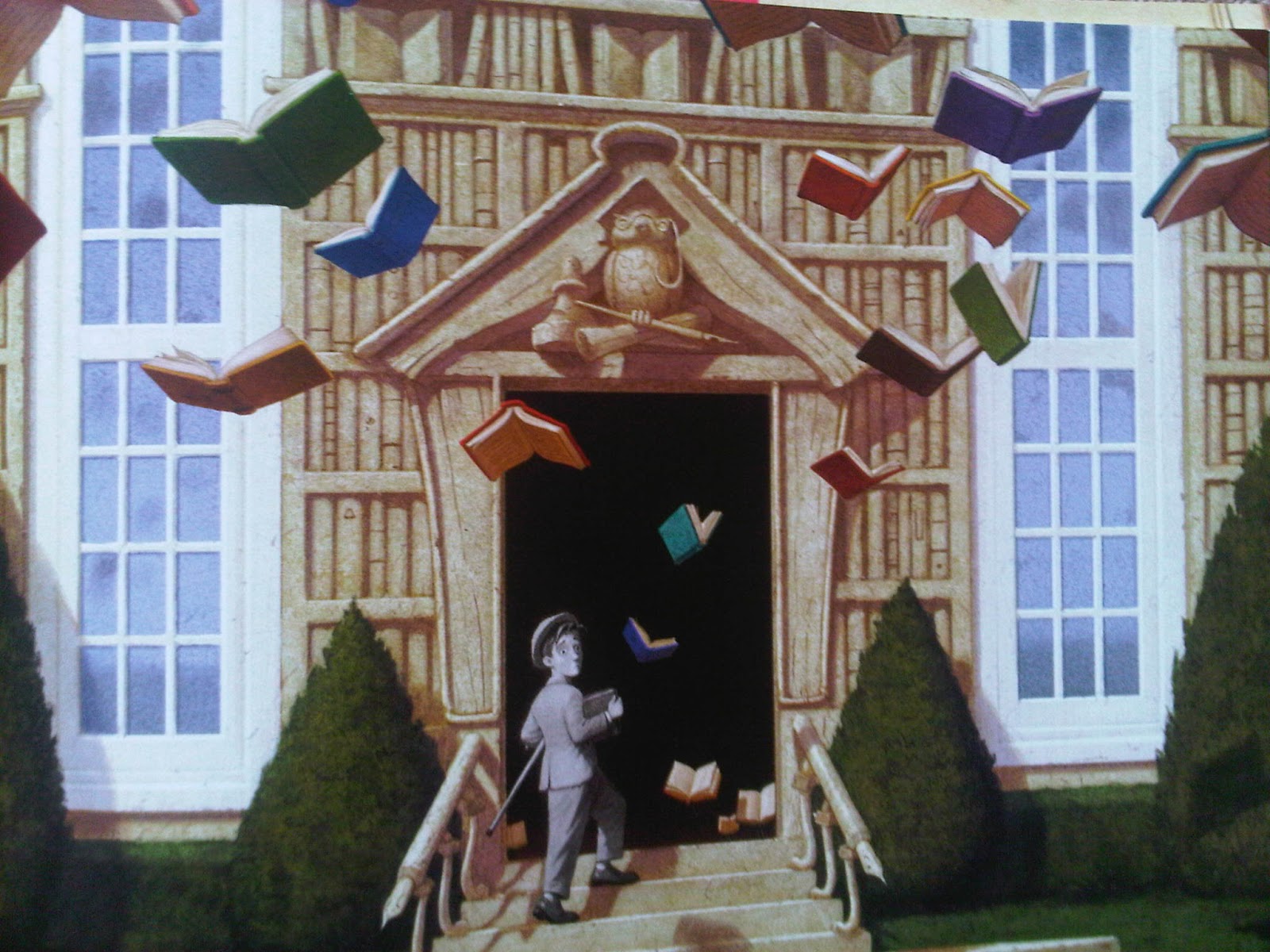
To recap the story – reader Morris Lessmore has his life thrown into chaos by a violent tornado.  Walking through the wreckage, he sees the vision of a beautiful girl carried away by books as if lifted by balloons.  He enters a magical library, where he spends the rest of his life caring for the books and sharing them with the world.  (Visitors to the library enter in black and white and leave in glorious color.)  After decades in the library, an elderly Lessmore leaves as a young woman comes to take his place.
While the film is dense with mystical passages, the book provides different conundrums.  With snappy pacing and retro visual style, we watch Lessmore spend his life tending books in a massive library.  But while he is caring for the books there – and sharing them with people in need of the curative powers of fiction – he also closes each day by writing in his own journal.  As Joyce writes, The days passed. So did the months. And then years.  When an elderly Lessmore finally leaves to join eternity, he leaves behind him his own book.  As Joyce writes, His life was a book of his own writing, one orderly page after anotherHe would open it every morning and write of his joys and sorrows, of all that he knew and everything that he hoped for.  The contents remain a mystery to the reader, but the question must be asked: is the library really a metaphor for our lives, with each book representing every life lived?  Or is Joyce saying that each and every life is a book of blank pages, to be filled with deeds good or bad, as our final contribution to the great library of the world?  Or is Joyce saying that we must leave books of value (or lead lives of value) for those who will come after us?  (A typical Joycean detail is that the top of Lessmore's pen forms a question mark.)
The very malleability of the story is one of its great satisfactions, along with the Joycean habit of including references to beloved pop culture touchstones, including everything from Winsor McCay to Buster Keaton to The Wizard of Oz.  It is no wonder that Lessmore spent several weeks on the New York Times bestseller lists – and as the holidays near, it would make an ideal gift to a young person starting on the personal, life-changing journey of reading.  The art (in collaboration with Joe Bluhm) is transcendent — a visual feast for young and old alike.  More important, after sharing Morris Lessmore with a child (or lucky adult), it is interesting to ask the listener, what do you think it means?
In other Joyce news: two new volumes in his ongoing Guardians of Childhood cosmology are just arriving in bookstores now: Toothiana, Queen of the Tooth Fairy Armies, is a young adult novel, and the picture book The Sandman: The Story of Sanderson Mansnoozie.  Expect reviews in the weeks to come.