Showing posts with label Bob Brier. Show all posts

Wednesday, April 9, 2014

Egyptomania, by Bob Brier


Many know Bob Brier (television’s Mr. Mummy) through his many televisions appearances, as well as through such best-selling books as The Murder of Tutankhamen, The Daily Life of the Ancient Egyptians and The Secret of the Great Pyramid.  We were lucky enough to do an extensive interview with Bob that will run soon in these pages, but, for now, let’s look at his latest book, Egyptomania.

If we at The Jade Sphinx have a taste for all things Egyptian, we are the merest pikers compared to Bob Brier (born 1943).  He has coined the word Egyptomania to cover everything from a passion for exquisite antiquities to a taste for Egyptotrash.  In his book Egyptomania, he charts a course of the West’s love of all things Egyptian starting with the Roman invasion all the way through to the Napoleonic wars that brought scores of artists and scholars to the region, and the bursts of King Tut craziness that erupted with the discovery of his tomb and through the revival of interest in the 1970s.

It is all much of a muchness to Brier, whose enthusiasm is boundless and indiscriminate.  More important, he manages to bring a remarkable variety of things to life, from shipboard explosions during the English attack on French forces during the Battle of the Nile, to the sometimes bizarre juxtaposition of various ancient cultures on cigarette boxes in the 1920s.  (Some of these images, despite their inherent silliness, are wonderfully evocative Art Deco and Art Nouveau compositions.)  Brier has written a book that is completely accessible to all ages, and can be read with satisfaction by adults or presented to younger readers who are cultivating their own interest in Ancient Egypt.

Brier wonders aloud why Ancient Egypt has such a grip on our imaginations, and not, say, Ancient Mayans or the Babylonians.  He believes that it is an odd mixture of the familiar and the exotic: while believing in jackal-headed gods and the actual physical resurrection of the body, the Egyptians also had a surprising modernity in medical research, statesmanship and religious philosophy.  They are different… but not enough to be completely alien. 

Equally important, an enthusiasm for Ancient Egypt has a wonderful zest and, well… zaniness that makes King Tut breakfast cereal possible, along with scholarly research on hieroglyphs.

Brier’s book makes many interesting side-trips, among them the various engineering feats that made the transportation of Egyptian obelisks possible to Rome, London and New York.  The stories of these three voyages are book-worthy in themselves, and Brier does a terrific job of maintaining a zippy narrative while keeping track of all the moving parts. 

Also delicious is Brier’s argument that the start of Egyptomania was during the Ancient World.  The Romans were enthralled by the hieroglyphics they could not read; while Alexander the Great (who nearly conquered all of the known world), wanted to become an immortal pharaoh.  He also relates how Emperor Hadrian built Antinopolis as a memorial to his lover, the beautiful Antinous.  We have never fully recovered.

As we grew up on Boris Karloff, Lon Chaney, Jr. and Christopher Lee emerging from behind Egyptian pillars to put the whammy on various reincarnated loves, Brier’s Egyptomania was catnip to us.  We highly recommend his book to anyone with even a passing interest in the subject.

Monday, November 25, 2013

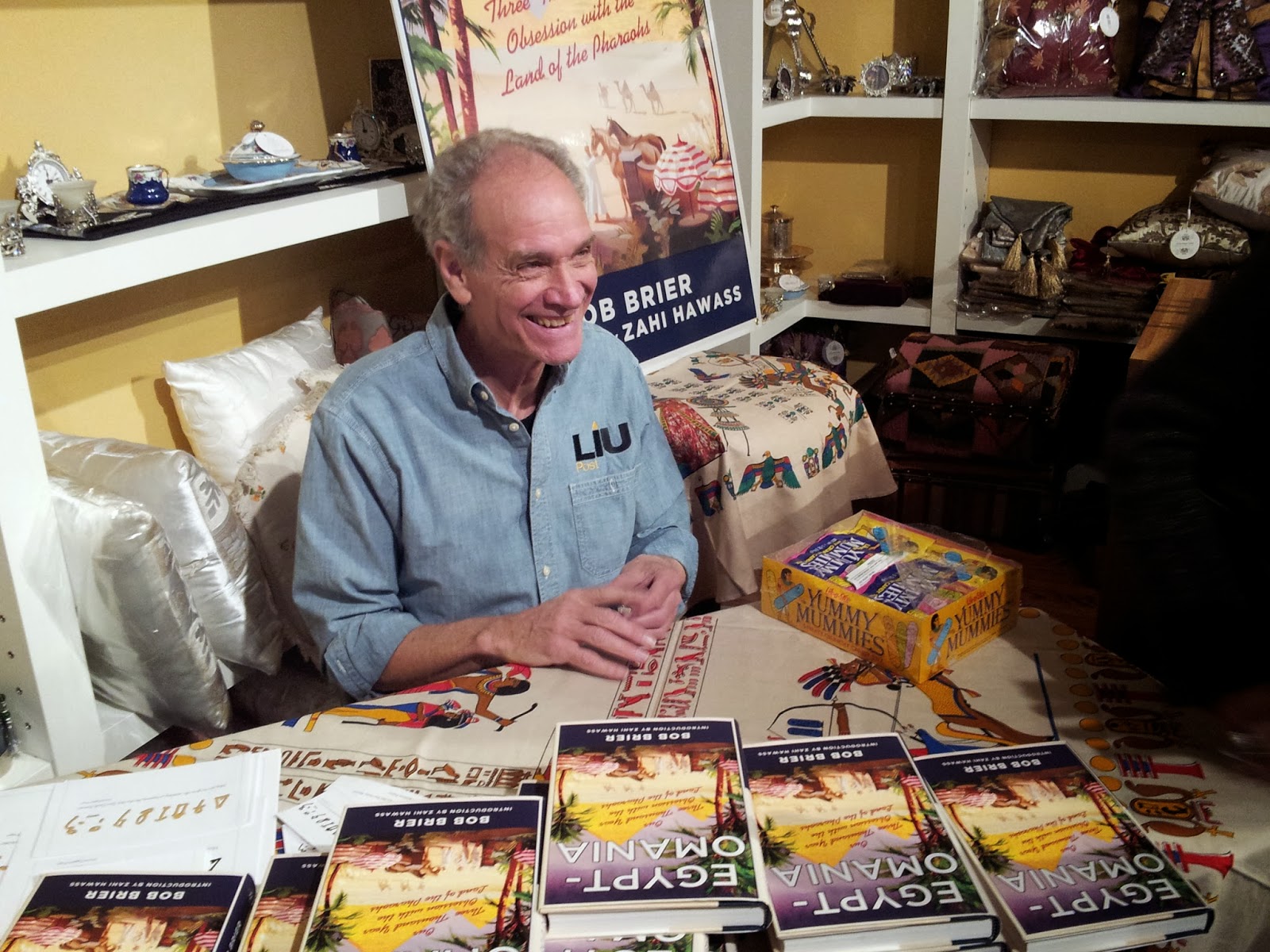
Egyptomania Hits the Dahesh


Yesterday the Dahesh Museum Gift Shop in Hudson Square played host to a capacity crowd for the debut of Bob Brier’s new book, Egyptomania.  Brier is, of course, the celebrated egyptologist who has written eight books, including The Murder of Tutankhamen, and was host of television’s The Great Egyptians and The Mummy Detective. 

Though an academic with multiple degrees (including actually getting a medical degree to better understand the underlying cause of death of the mummies he has examined), Brier brings to his field of expertise an infectious sense of fun and a true sense of wonder.  Rarely have I laughed so much at a lecture, nor can I remember having been regaled with stories by an expert who is as much entertainer as academic. 

Brier’s book chronicles our three thousand year obsession with the Land of the Pharaohs, and provides a wonderful juxtaposition between the learned (his chronicle of Napoleon’s invasion of Egypt, complete with a retinue of savants to provides what might be history’s first ethnographic study) and the commercial, cataloging “mummy” sheet music, Cleopatra cigarettes and mummy movies featuring everyone from Boris Karloff to Peter Cushing.

Brier argues that no ancient civilization compares to Egypt for its romantic hold on our imagination.  He thinks this is a mixture of our fascination with mummies (here – easily recognizable – are human beings who walked the earth thousands of years ago); the art of Egyptian hieroglyphics; and, of course, what he calls “the Indiana Jones effect.”  Egypt has inspired exotic adventure fiction from pens as diverse as Sir Arthur Conan Doyle, Sax Rohmer and H. Rider Haggard – and this touch of exotica continues in the films of Steven Spielberg and Stephen Sommers.

Your correspondent had the pleasure of interviewing Brier at his home in the Bronx, which is crammed with enough Egyptian artifacts to gladden the heart of Indiana Jones.  That interview, along with a more detailed review of his book, will follow in a few weeks.

In other Dahesh news, the country’s premiere museum-without-walls, has taken the remarkable step of purchasing Frederic, Lord Leighton’s imposing Star of Bethlehem, to expand the scope of the current exhibition, Sacred Visions: Nineteenth-Century Biblical Art from the Dahesh Museum Collection, on view until February 16, 2014 at the Museum of Biblical Art.  Curators and directors from each institution immediately agreed to add the painting to the current installation, as this presented a once-in-a-lifetime opportunity to see the Leighton alongside other like-themed treasures.  The exhibition traces the renewed interest in Biblical myths following the expansion of biblical archeology and the advent of photography, which produced travel books with pictures of the Holy Land.

Curator Alia Nour said last night, “We decided to remove two smaller paintings to make room for this very large one and started to work on a new label. We deemed it worthwhile to give visitors access to one of the most powerful biblical works Leighton produced during the 1860s.”

New Yorkers who have not yet seen the show now have added impetus, and those who have already seen it an added reason to see it once again.  The Museum of Biblical Art is at 1865 Broadway at 61st Street, and admission is free.  For more information, call 212.408.1500.