Friday, September 16, 2011

The Lute Player by Norah Lofts


Norah Lofts (1904-1983) has a loyal and respectful readership among those who actually read books, rather than talk about them.  There is a small and passionately devoted reading class (Robertson Davies called them the clerisy) for whom the reading of novels is nearly an act of devotion and your correspondent hopes to number himself among this blessed few.
So when fellow travelers of the printed page recommended Norah Lofts, attention had to be paid.  Quite a successful novelist in her time, Lofts wrote three novels set in the same country house in Suffolk, England, a number of mystery novels under the pen name Peter Curtis, and several historical novels.  My introduction to Lofts was her deeply moving novel about Richard the Lionhearted, The Lute Player (1951).
Usually, there are two types of historical fiction.  One strings momentous events into some kind of narrative, usually propelled by a key historical figure.  (An excellent example of this would be Anouilh’s Becket.)  The other type usually focuses on some kind of personal drama involving fictional characters played out against the backdrop of history.  (My favorite example here is Rostand’s Cyrano, where the battle of Arras is largely a matter of who loves whom.)  The Lute Player is actually a wonderful synthesis of both approaches.
The novel is the story of Richard Plantagenet and the Third Crusade into the Holy Land.  His vision was to Christianize Jerusalem and thereby create a multi-national Christian kingdom.  (Imagine the changing tides of history had he succeeded.)  It is told through three vastly different viewpoints, that of Duchess Anna Apieta (a wholly fictional character), Richard’s mother, the historical Eleanor of Aquitaine, and Blondel the lute player (a character of disputed historicity).
The Lute Player is a novel of thwarted passions, sexual and otherwise.  Anna Apieta loves the lute player Blondel.  However, Blondel loves Berengaria, princess of Navarre; she, in turn, loves Richard Plantagenet.  But Richard loves both Blondel and, more importantly, a vision of what his kingdom would be once he has secured the Holy Land.
This simplistic summation may be misleading – rest assured that The Lute Player is no Harlequin Romance in armor.  The passions of the key characters drive their personalities, and are often the root causes of decisions that change the course of history.  Lofts writes with keen psychological insight and deep sympathy for her characters; her gaze is steady and critical, but charitable nonetheless.
Here is a snippet where Blondel awakes, wounded on the battlefield.  On one side of him is a dead man, on the other, a man whose mouth and jaw have been hideously damaged by a sword:
Presently I was conscious of a smell of boiled mutton mingling with and then overpowering all the other smells.  I opened my eyes again and saw two men, one carrying a great steaming bucket, the other a ladle and a number of bowls.  “Who’s for mutton stew, fresh mutton stew?” cried the man with the bucket.
“Dead,” said the one with the bowls, peering at my right-hand neighbor and moving on to peer at me.  “The next is all right.  Hi, boy, want some fresh mutton stew?  Put you on your legs in no time.”
“No, thank you,” I said, and ridiculous fresh tears came into my eyes as I thought how welcome, how wonderful, fresh mutton stew would have been last night; to me with an unsickened stomach, to the man on my right who would never enjoy anything again, to the man on my left who last night had had his teeth and his lips and his tongue as God made them.
Good stuff.  Even better is how Lofts can delineate character in a few deft strokes.  Here is Anna Apieta on an abbess:
She had a keen brain and, in any matter disconnected with the religious life, a sense of justice, a gift of logic.  Professionally – and religion with its many ramifications was to her a profession rather than a vocation – she was unjust, illogical, dictatorial to an unimaginable degree, and unbearably superior.  So armored, so immune, that often words failed me and I longed with childish fury to smack her smooth plump face.
The Lute Player is most deeply satisfying as an investigation into the mystery that is Richard the Lionhearted.  For a mainstream novel of 1951, it treats his homosexuality in a surprisingly nonjudgmental way, and one of Blondel’s major difficulties is his own inability to respond to Richard: …I began to reckon his many virtues, his great courage, his justice, his attention to detail, his lively mind, his fortitude in adversity; even the fact that he was, when he chose, a minstrel without peer leapt up to give me a sharp stab.  I had always preserved a sense of proportion in my attitude towards him, had never fallen into the state of hero worship as many diverse kinds of men had done.  In the great days of his triumphs and resounding exploits some corner of my mind had stayed sour.  Now in the days of his failure, with his fatal weakness exposed, my cursed minnesinger’s art set to work on him and I saw him as a great man, a hero – rebuffed by a sniffling, prudish little lute player.
But Richard also uses people indiscriminately to achieve his own ends, mercilessly slaughters captives, and is responsible for the death and mutilation of legions his own men and his enemies.  At what point, Lofts seems to ask, are the great deeds of great men not worth the horrible price that accompanies them?  It is a timeless question, and we are no closer to an answer now than was Lofts, nor even Richard the Lionhearted.

Thursday, September 15, 2011

An Interview with Composer James Bernard, Part III

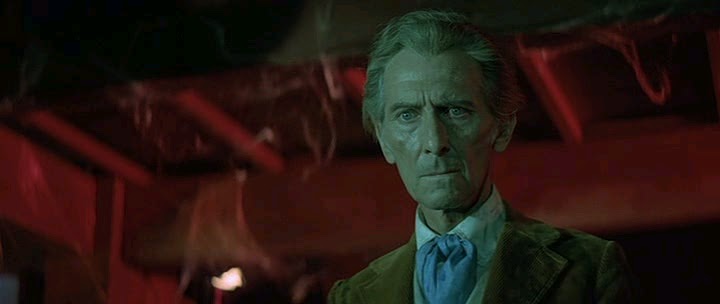
Peter Cushing, Star of Many Hammer Horror Films

Leaving his life with writer Paul Dehn, here composer James Bernard talks about his career writing music for a series of English horror films…

Back to the Hammer Films, although I find this a lot more interesting --
I agree!
So, there you were with The Quatermass Experiment, and jumping into the Frankenstein and Dracula films. Was all of this a cultural shock for you?
Not at all. I'd been reading horror stories since I was a boy. It's always amazed me later -- the three books that I had adored in my boyhood were The Devil Rides Out, She, and The Hound of the Baskervilles. I must've read them in my middle teenage years. So later ,when I found myself actually writing the music for the film versions of these books, I thought this was almost a miracle! So it was no shock at all. In fact, I had been collecting anthologies of horror stories for as long as I could remember.
The only regret that I tell people is that I would've loved to have written more romantic scores, like She. In the Dracula things, for which I'm eternally grateful, there wasn't always a chance to do a really nice, romantic score. There were two, little romantic bits in Taste the Blood of Dracula and Scars of Dracula. I just adored the whole business of film making. It's unfortunate that as the composer, I wasn't called down to the set all that often. I usually didn't see anything until the actually filming was mostly or completely finished. I was never on the set unless it was during a scene that needed music during the actual filming, like the Egyptian nightclub scene in She, where you need the Arab music. All that Arab music is mine.
I thought that was all archival music.
I'm very pleased by that. You have to immerse yourself, and see how it sounds, and than create something that is evocative of that sound. Another instance is in Kiss of the Vampire. There is a scene where there is a vampire ball, and all of the sort of Viennese waltzes are by me, too.
Again, I had thought that was archival!
No, it was me! So, when they needed that, I wrote several waltzes that blended one into the other, and wrote one main one.  If all goes according to plan, Silva Screen will record some suites from She, and the main waltz from Kiss of the Vampire, to a new arrangement I have done. There were some themes from She that I would've liked to have expanded, and I have done so for this new recording. There never was much time for it in the movie. I was always sad they didn't ask me to do The Vengeance of She.
When you were going to do the first Dracula or Frankenstein film, were you familiar with the tradition of movie music from American horror films?
Not at all. I used to love going to the movies, but I never made any studies. It was just my idea on how to do it, really.
 And you had no familiarity with the Italian vampire operas of the last century?
Not at all. It was all new to me. I did what I thought would be right. Paul and I used to think of things together, and when it came to Dracula, he said that the name Dracula certainly suggests something musically. That's how I came up with the theme. Listen, next time, and you'll hear: "DRAC -- u -- la!" And that was just from the two of us chatting.
The closest I had ever come earlier to thinking like this, was with the Duchess of Malfi, which as I said, is really sort of a horror play.
As the quality of the Hammer Dracula films declined, did it affect at all your enthusiasm for composing for them?
I can't really be objective about that, I was too closely involved. I really wouldn't like to offer an opinion on that. Some of the later films, like Frankenstein and the Monster From Hell, were very good. It was a great loss, of course, when Terence Fischer died. But because I was not involved in too many of the later Hammer Films, I don't think I can offer an opinion.
You wrote a wonderful score for what might've been the best of the later Hammer films, Frankenstein Must Be Destroyed.
 I like that film and I like that score. I was called-in when the film was more or less complete, and I would see the film in a little viewing theater in Soho, and plan out the music. At this time, I'd put together a music breakdown when the film was near its final cut. We'd go through it reel by reel, and if the producer was Anthony Hinds, he'd sometimes be there, and the director too, if he was interested. Terence Fischer was such a charming, wonderful man, but he never came to our music sessions! I once said to him, "Terry, don't you ever want to come and see what we're doing?" And he said, "No, I know nothing whatever about music, and I feel it's not my part of the film. I'm always happy with what you music boys do, and I trust you!"
Anthony Nelson-Keyes, when he produced, would call me now and then for my ideas on the main theme. I remember banging out for him an idea for Frankenstein Must Be Destroyed on a battered, upright piano. He smiled, and said "Press on!"
The editor, his assistant, and soundtrack people would be there, too, to integrate sound effects like thunder and sounds of rain. And after all that was done, I would end up in my music room with my manuscript and my piano.
I haven't changed the way I work.  I've just done this 90 minute score for Nosferatu, and I just worked with manuscript paper, a pencil, a ruler, an India rubber and a grand piano.
With all of your work appearing on CD, did you anticipate the tremendous longevity of, and continued interest in, your work?
Not for a single moment. Nor did Hammer! For all the people involved, especially on The Horror of Dracula, it was just one of those golden moments where things came together totally by chance. A chance teaming that really delivered the goods. Hammer was doing a number of films of all types, and I was just doing my work amidst the usual panic, working most of the night, to get the thing finished on time.
So it is quite wonderful that all this interest has come round that people want to hear the score without seeing the movie!
Any memories of Peter Cushing or Christopher Lee?
Cushing was always so sweet and so charming. I last saw him in 1994, when my friend Ted Newsom made the documentary Flesh and Blood. We went down to Canterbury, and the last thing poor Peter ever did was record his part of the narration for this documentary. We took Christopher Lee down with us to Canterbury, we all came to Peter because he was so ill, and found a studio in Canterbury. Peter came with his nurse Joyce, and her wonderful husband, who both looked after him wonderfully. Peter and Christopher had a delightful reunion; I don't think they had seen each other for some time. Peter was just the same, he was so frail and thin, but he was charming and sweet as ever.
Christopher, is of course, a charming man, too. Brilliant and erudite, a gifted linguist, a man with a strong personality. I have happy memories of them both. And my days at Hammer.

So ends our interview with James Bernard – a fascinating life!

Wednesday, September 14, 2011

An Interview with Composer James Bernard, Part II

The Enigma Machine!

Welcome to the second part of our interview with film composer James Bernard.  Here, he just lobbed a fascinating bit of trivia – he was involved in the famous Enigma machine incident of World War II.

You were involved with the Enigma machine?
Yes, I was a very humble cog in that great wheel of breaking codes and translating them and finding out what was happening overseas.
Now was that MI5 or MI6?
Neither, really. I was in the Air Force, and it was a whole branch of its own. It's all been written about, so I can talk about it now. It was in a little town near Manchester. After my initial training, I was on the Japanese side, I had to do a six month course at the School of Oriental and African Studies at London to learn a basic amount of Japanese. I was sent, then, for a course of cryptography, so I could make codes. I never really understood it, and I wonder how I got through! Then I ended up working with that brilliant chap Alan Turing, who eventually ended up breaking the Enigma codes. He was a wonderful character who later, alas, killed himself. But that is a whole other story, which you may know. There was a wonderful play about him in London a few years ago...
Breaking the Code.
You know it, yes. So I was involved in all of that, but really in a very humble way. But all during this time I kept in touch with Ben Britten, and at that stage I really figured that I was going to be a concert pianist. I used to see him, and listen to his concerts in London, and he told me that when I was in London, I could go on-stage at concerts with him and turn the pages for him. So I sat by him and turned the pages, usually for some new piece he was doing, or had just written, and hadn't committed to memory. But all this time, I was wondering what it was I really wanted to do. I had also thought of being an actor, and you see, which is part of how I came into films because I was always stage struck.
 It was during this period that I got to know my great friend, Paul Dehn. He was a Major by then, and in MI6. We met in 1944, and we then remained friends for more than 30 years, when he died in 1976.
So coming forward in time, after I finished with the Air Force, I went to Ben Britten for advice. I had decided by this time that composing was my thing, and he said what I had to do was go and get a proper grounding in all the techniques of music, all the basics. You've got to learn all the rules, before you can break them! He told me to get to one of the top colleges or academies of music, and of course at that time, 1947, because I had been in the armed forces, I was able to get a government grant to pay my way. So after the entrance exam, I went to the Royal College of Music in London. The government put me through for two years, through '47 to '49, and I studied under a wonderful composer named Herbert Howells. He taught me discipline.
If you come across his music, it's wonderful. He's having a great resurgence of popularity here in England. He had been a brilliant young composer who had a terrible time because he had a little son whom he had adored, and this son was killed when he was about 9 or 10. Howells was never the same since. 
I was also studying concert piano, but there were so many brilliant artists at the time I knew it wasn't for me. So I stuck with composing, because I thought I did have a little bit of talent there.
When my time at the Royal College came to an end, and I was sharing an apartment and later a house with Paul Dehn. He was a little older than I, about 13 years or so, and was a well known film critic and poet. He was writing plays for the radio, that's going back to the days when radio was infinitely more important than TV! They started something called The Third Program, it's still on BBC radio, and they specialized in classical music and production of radio plays. The play was The Death of Hector by Patrick Pickinson, a rather good poet who's unfortunately dead now, but only recently after a very great age, and he asked me if I would do the music for it. It was directed by Val Gielgud, older brother of John Gielgud, who later on became a great friend of ours in later years. So Val directed this play, and in those days we didn't even pre-record the music. The play was taken from an episode of The Iliad by Homer, regarding the death of Hector, Trojan Wars, and all that. I wrote it for a small group consisting of a harp, flute and percussion. I think that was about it. It was played in the studio, live, while the play was being broadcast. And that was my first introduction to any kind of dramatic music! It was conducted by John Hollingsworth, who later became music director for Hammer Films. He was also a good friend of mine and Paul's.
After that, the BBC began to employ me a lot to score radio plays. I was longing to get into movies, but film producers couldn't care less that you have written lots of music for radio plays! So you have to wait until somebody comes along, and is willing to try you out.
I did the music for a wonderful play by Webster, who came a little after Shakespeare, and wrote a wonderful sort of horror play called The Duchess of Malfi. It was an all star radio production of the play, with Peggy Ashcroft, unfortunately gone now, and Paul Scofield. I did the score for strings and percussion, which seemed suited to it. It all seemed to work well. Just after that, John Hollingsworth had become music director at Hammer Films. Anthony Hinds, who was one of their great producers, who retired quite early, mostly because he likes his privacy, was producing The Quatermass Experiment. In America it's called The Creeping Unknown. He rang up John Hollingsworth and said, "What am I to do? The film is nearly ready, it's time to do the score, and John Hotchkiss, who we had lined up to do the score, is ill!" So John, very sweetly, went to Tony Hinds with a tape of The Duchess of Malfi, and got me the job! I'll tell you what the fee was, it was 100 pounds, which, of course, in those days, seemed quite large and was fine for me! Thank heaven I took it, for they liked the score, and the whole thing went off from there.
So, that's how I got into films. Hammer went on asking me to do scores for them, for which I have been eternally grateful.
Could you tell me a little about your life with Paul Dehn at this time?
Well, we were very happy together! We mentally clicked, just clicked in every way, so we settled down together. He came out of the Army a Major with a very good war record -- he trained spies, you know, that was his sort of thing. He was brilliant linguist, particularly in French, so he was working for MI6. Of course, I didn't know all of that at the time, we were all discreet about that. But as soon as we could, we started sharing an apartment together, and that was during my last year in the Air Force, in 1946. Paul had gone into civilian life already, and I was posted to the Air Ministry in London, where I was helping to write the history of the Air Force. We had a very nice apartment up Kings Road. He was already working for the BBC writing radio plays, and writing as a film critic for The News Chronicle.
Was Paul a writer before the military?
Yes, he was trained as a journalist, but he put it off as he was called into the Army. His godfather was a brilliant dramatic critic named James Agate, who was drama critic for the Sunday Times.  He gave Paul a lot of extremely good advice, and Paul followed his example. Paul was also a poet, and he wrote three or four books of just lovely poetry, the first one of which, The Day's Alarm, he dedicated to me. He was a brilliant lyric writer.  We actually worked together on one musical. I would've loved to have written more tunes, but, of course, I became known as the fellow who wrote for Dracula!
So we lived together from 1946, till 1976, when Paul died of cancer. He smoked like a chimney. I'll always remember, in our early days together, he said, "By the way, I know I'm not going to live to a great age. I just know it, so don't expect me to!"
What did he think of your work in Hammer Films?
Paul was a very respected film critic. Because he was creative himself, film people always respected his criticisms tremendously. He would go into a film wanting to enjoy it, he had a great enthusiasm. He always wanted things to be good. Well, he was one of the only critics in the early days of Hammer Films, when they became internationally famous, that was not shocked or horrified at Curse of Frankenstein or Horror of Dracula. Critics thought they were too gruesome, too terrible, while of course, they are nothing compared to what is seen today. It wasn't only because I was his friend -- very often, he never mentioned the music!
As the years went by, Paul wrote a movie, Orders To Kill, later directed by Anthony Asquith, who was the son of a former Prime Minister. Paul was a contemporary of Terence Rattigan, the playwright, who was one of his greatest friends. So, as the years went by I knew the most wonderful people through Paul! But with Orders To Kill, Paul crafted a stark, grim spy story.
After Paul started writing films, he was working as a critic, too, until one day he decided that he could not continue doing both. He felt as if he was in two camps at the same time. He decided to take the plunge, and wrote screenplays exclusively. I encouraged him, saying, "C'mon, Paul, you don't want to be a critic any longer -- be completely creative!"
The two films that really got him through into the big time were Goldfinger, and The Spy Who Came in From the Cold.
Two very different types of films.
Very! Goldfinger he did because people thought he knew all about the spy business!  Of course, both films were about spies, but they were two very different films. Later, Paul did the screenplay for Le Carre's The Deadly Affair. I still have inscribed books from Le Carre with lovely inscriptions to Paul.
So, while I worked with Hammer, Paul worked on very big films.
Wasn't Murder on the Orient Express one of them?
Yes, that was his last movie, and he was nominated for an Oscar for that. It was the same year as Chinatown, and Robert Towne won. Just when Paul finished writing it, he discovered that he had lung cancer. Paul and Sidney Lumet worked well together, Lumet also directed The Deadly Affair, so they hit if off from the word go.
And Paul, of course, also wrote several of the Planet of the Apes films!  They are so inventive. There's a funny story behind them. Paul got to do the first sequel, which was Beneath the Planet of the Apes, with Maurice Evans. When he did it, the producer, Arthur P. Jacobs, who had a very hard bitten exterior, but inside was a soft, bleeding heart, told him that there was only going to be one sequel, and he could blow up the whole world if he felt like it. So Paul went right ahead, and blew up the world.
Beneath the Planet of the Apes was such a success, Jacobs called and told Paul that somehow he had to undo what he had done! Paul and I started talking it around, we always discussed our projects, and soon he came up with a time warp story that became Escape From the Planet of the Apes, which started the whole series over again from whatever the present year was.
It was a very clever way of working around it.
Thank you. We thought of that together. I must take that little bit of credit.  Did you know that Paul and I each won an Oscar in 1951?
You did?
That's a very peculiar story, for it has nothing to do with my music. It was before Paul had really become a film writer, and we had both thought of an original story for a movie. We sold it, just as a story, to two brothers, the Bolting Brothers, who made some very good films in those days. They turned it into a film called Seven Days Till Noon. It was about an atomic expert who has a religious conversion, and steals an Atomic Bomb. This was right after the war, when there were still a lot of ruins in London, and he hid it somewhere among the ruined buildings. He tells the government that Atomic Bombs are a great evil, and unless they dismantle their arsenals in seven days, he will detonate the bomb and destroy London. He vanishes, and they can't find him. Soon, they start evacuating the whole of London, and in the end he is found holed-up at the alter of a ruined church. The bomb is de-fused literally about two seconds before it is due to go off.
We sold the story outright for peanuts. And to our amazement, an Oscar for Best Original Screen Story was awarded to the both of us. No one told us! We didn't know anything about it! One morning, we were reading the news of the Oscars, and found out we had won! No ceremony, no flying to Los Angeles, nothing. It was very quiet. Somebody from the Academy of Motion Picture Arts and Sciences telephoned us and said he had our Oscars, and would we like him to bring them round? We had a little house off Kings Road, and soon this charming American man came over for a drink with a cardboard box, had a gin and tonic, and handed us Oscars. He finished his drink, and away he went! I still have both of them.
Is Seven Days Till Noon on tape?
 No, I don't think it is. It's very good. Black and white, very exciting.


Tomorrow we conclude our interview!

Tuesday, September 13, 2011

An Interview with Composer James Bernard, Part I

Composer James Bernard

In going through my files this weekend, I found an unpublished interview I conducted with film composer James Bernard (1925-2001).  Though primarily a film composer – writing mostly scores for a series of British horror pictures made by Hammer Films – he was also a screenwriter of note.  There were many surprises in store for me, as Bernard’s life was a rich and varied one.  So, onto the first part of our interview with James Bernard, conducted for a now defunct film magazine in April 1996…

After a career that included working with composer Benjamin Britten, helping the Allies break Axis codes during World War II, winning an Oscar for a story idea conceived with longtime companion Paul Dehn, and friendships with such film and theater notables as Sir John Gielgud, it is perhaps somewhat ironic that James Bernard is best known as the composer who scored Hammer's horror films.
But write the scores for these films he did. A delightful man with a warm and gregarious manner, Mr. Bernard tells stories with all the fun and enthusiasm of a much loved uncle. He graciously shared his memories with us, seemingly the least of which was his involvement with the Hammer House of Horror...
Could you give us some of your background?
I was born in a rather romantic place, really. My mother and father were English -- I'm going back, of course, in 1925, the days of what was known as the British Raj, when India was part of the British Empire -- and there was a whole section of the army out in India. My father was a career soldier, a very distinguished soldier. He was forced to retire just after he had been made what was then called a Brigadier General, because he had high blood pressure, which today, of course, they would've been able to cope with. In the end, it was what killed him. I was born, I think, before the partition of India into India and Pakistan. I think I was born in Pakistan, in a little hill station in the Himalayan Mountains. It was a rather romantic background!
How long were you there?
Well, one went rather to and fro. My father used to get leave, because when you were in a far flung corner of the Empire, you were in one place for about six months, and then went home for about six. Of course, one went by ocean liner, so it took two or three weeks to get home! So, I think I was back twice to Delhi, which was where my father was sort of ADC to the Commander and Chief. But I think I came back in 1930-31 or so, when I was about five.
And where was home then?
We lived a lot of the time with my mother's parents, who had, at the time, what you would've called "A Stately Home." That's English terms for this sort of great, big country mansion. It was in Gloucestershire, which is in the West Country of England. And they had a great big house called Puckrup Hall, and it was a stately home where my brother and I were brought up. This was in the days where these homes had a big staff: house maids, parlor maids, a chauffeur, a cook, and a nanny who looked after us.
It sounds like a dream.
It was wonderful! We had these lovely grandparents, my mother's mom and dad, and we were brought up near rolling fields and meadows. And there was a farm run by tenants who grew apples to be used for cider. We used to go down to the big orchid to see the apples trampled for cider. The horses pulled it round and round. That's the background.
Now when you were a child, were you interested in music?
Yes. I started playing the piano, we had a lovely upright piano in the nursery, when I was about six or seven. I was just attracted to this piano, it was quite a famous make, called a Broadwood, and I'm sure there's still a Broadwood in London somewhere upon which Chopin played. It was a celebrated English make of piano. And so I used to go to this piano and play around, and do whatever I felt, so my parents said I had better have music lessons. So I had lessons from the time I was seven.
Were you interested in composing early on, or did you see yourself simply as a performer?
At that stage, I thought I was going to be a performer. But I loved playing around, so I suppose I was composing in a totally disorganized way! Soon, I was sent to what we called a Prep School, which is quite different from what you in the states call a Prep School. One went to a Prep School, which means a Preparatory School, where one went from about seven or eight years old till about 14. I went on from there onto a school -- well, it's all very peculiar, because in England we have what are called public schools which are really private schools. So I went to a one called Wellington College, which was very well known and still going strong, and was founded by Prince Albert. You know, Queen Victoria's husband. It was supposed to be for sons of military people -- Navy, Army and like that. My father, being a regular soldier, sent me there. It's funny, for while the training was like a military academy, they had a very strong artistic side. And it's always been my theory that the sons -- it was all boys, you know -- that the sons of soldiers rebelled against their background and wanted to do something different. So we had a very strong artistic side. I was greatly encouraged with my playing and composing. I should also add that I'm directly descended on my mother's side from Dr. Thomas Arne, who was a 17th Century composer, who wrote Rule Britannia. He wrote a lot of operas, too, and stage music. And I've always thought that if he were alive today, he would be a very busy and very popular film composer!
How did you get from a career of straight composing and into films?
Well, let me go back. During my last term at Wellington, the composer Benjamin Britten was just writing his first great opera, Peter Grimes. Britten came to the school at the time, about 1943, because our Art Master was a man named Kenneth Greene, a celebrated theater designer. He wasn't in the armed forces, so he was teaching art at Wellington College. And Ben Britten, who I later worked for and became very friendly with, had written Grimes and wanted Greene to design sets for the first production of the opera.
I saw Grimes at the Met last year.
It's a wonderful opera, isn't it?
It is, but I prefer Billy Budd.
Well, I've just seen that again in London, and it's the one that I actually, personally worked on. So, when Ben Britten came to the school, he wanted to meet any boy who was considered musically bright. And I had already started composing little snippets, and such, so we met. I had shown him some bits I had written for an inter-house music competition, and he took a great interest in my work. He always used to call me Jim, instead of James or Jimmy, and he said just before I was going into the RAF in September 1943, "Jim, here's my address, keep in touch with me."
So I went to visit him in London, where he was living with Peter Pears, who was his great, life-long friend, and a celebrated singer. I became very friendly with them. At the time I was in Military Intelligence, which was all highly secret, but now has all been written about. A lot of that was covered in a recent book, which just came out to very good reviews, called Enigma, which is all about breaking of German and Japanese codes, and translating them.

More tomorrow!

Friday, September 9, 2011

1939 – The Lost World of the Fair


My recent revisit with the work of William Joyce set my mind to thinking on the many things that inspire that delicious sense of wonder in me, and I found myself revisiting David Gelernter’s magnificent 1939 – The Lost World of the Fair.
As David Gelernter (born 1955) makes plain in his 1939 -- The Lost World of the Fair, wonder was in the air at that time. America looked forward to the future with what could only be called a breathless enthusiasm, a heady mixture of exhilaration and hope. It is this sense of wonder that is the central argument of Mr. Gelernter's alternately flawed and masterful new book.
The world of 1939 was congenial to wonder. The nation was on the road to economic recovery, and although a major European war loomed in the immediate future, people had hope for an ultimately better tomorrow. Americans were confident in their technology, their society, and their destiny.
Such enthusiasm were everywhere in the 1930s, including pop culture like the super-science exploits of Doc Savage and the great science fiction comic strips of the time.  The 1930s saw such dazzling visions of the future as the film version of Things To Come, and who could not relish such visions as futuristic airships and monoplanes in films like Just Imagine? The title of a popular pulp magazine said it all: Thrilling Wonder Stories.
The fair was sold as The World of Tomorrow. In 1939, the future was envisioned in colors running deep in awe and wonder. It was a bright, beautiful place, a wonderland just beyond our grasp, just over the horizon of tomorrow.
But, author Gelernter argues, the Americans of today are much better off than their 1939 counterparts. Why then, he asks, are we less optimistic? The future as predicted by the Fair -- faster cars, world air travel, television, medical and scientific advances -- has pretty much come to pass. Why then, the nihilism, the sense of despair, the dread of a dystopia in our collective sense of tomorrow?
Gelernter offers fascinating arguments for this change of perspective during the course of his tour of the 1939 World's Fair. It's impossible to read his text without a wistful longing for the future as envisioned by America's past. It is almost equally impossible to read of the New York of 1939 without a twinge of envy -- with it's streamlined style, sense of purpose, and giddy exhilaration, it's more like Mars than contemporary New York. The Lost World is not some dinosaur-ridden jungle, but America of the 30s, the ruins of which lay all around us.
While detailing the Fair, the author's prose rises to rhapsodic heights. Some extraordinarily evocative passages actually bring the reader there, standing on the pavement of the Fair, gazing at the Trylon and Perisphere. The reader is introduced to the wonders of the Democracity, the Futurama, the mysterious voder, and such marvels as robots and Vitrolite.
Whole passages of the book can be lifted and savored for the almost Ray Bradbury sense of poetry they evoke. It is impossible to read the closing two paragraphs of the prologue, for example, and not be touched by something mysteriously akin to magic. When Mr. Gelernter is in touch with this adventurous and enthralling past, his sense of wonder and enthusiasm is an almost palpable thing. It is with astonishment that the reader realizes that such virtuosity is present in sections of the book which are non-fiction.
Unfortunately, the author almost loses the entire ball game in the bottom of the ninth, with bases loaded. Gelernter has done exhaustive research to bring the 1939 World's Fair to life, but rather than deliver such first-hand observations piecemeal, he creates two fictional characters to deliver the goods. Unfortunately, these fictional constructs, a young couple Mark and Hattie, are a crippling miscalculation on the author's part.  As painted by Gelernter, the Fair was a mixture of the Land of Oz and Flash Gordon. It cannot help but be compelling. Tragically, he creates as tour guides two of the most obvious and obnoxious characters in recent times.
Mark is an architect, committed to a better world and a better tomorrow; Hattie, the willful and intelligent woman that loves him. Hattie wants marriage and children while Mark questions the wisdom of bringing children into a world where Hitler might rule one-day as supreme dictator.  The situation is hopelessly contrived, and Hattie and Mark are crudely drawn. It is in these passages that Gelernter's prose magic fails him completely. In a total miscalculation of reader sympathy and interest, almost the entire final third of the book is devoted to their story, a story which was predictable and pedestrian to readers even remotely familiar with the excesses of melodramatic story-telling. The Fair almost vanishes from view as Hattie and Mark play the turgid final act of their tragic story, while the reader desperately wants to get back to the Hall of Aviation or the Lagoon of Nations.
In other books, such tiresome diversions would be enough to destroy them utterly. Fortunately, Gelernter is a non-fiction writer of remarkable power and skill. When not doting on the make-believe doings of Hattie and Mark, he takes us into an America that is mystical in its other-worldliness.
By temperament and talent, David Gelernter is the perfect man to take us to this exciting time and exotic place. Gelernter is a celebrated scientist and historian and, ironically, one of the many victims of the Unabomber (in 1993 he lost several fingers and use of one eye opening a letter-bomb sent by that maniac).  With a scholar's perspective, he tellingly pegs the America that once was, and what it is today. Nor is 1939 -- The Lost World of the Fair a tragic lament for the country's love and faith in the future, a sentiment that seems lost forever. Gelernter is too much of a realist to be negative about the future, and he is adamant in his one prediction:  that one day America will once again have a sense of wonder for tomorrow.

Wednesday, September 7, 2011

The Man in the Moon by William Joyce


Last night your correspondent had the pleasure of attending the launch party for the new picture book by William Joyce, The Man in the Moon, held at Books of Wonder, one of the premiere independent book stores in New York City.  This is great news for fans of illustrated books and connoisseurs of children’s literature, as Joyce is a major talent who has been absent from the publishing world for too long, devoting his time and creative energies to movies like Toy Story (1995), Robots (2005) and Meet the Robinsons (2007).
Before looking at The Man in the Moon, first a brief word about Books of Wonder.  Located at West 18th Street in Chelsea, Books of Wonder has been an oasis for book lovers for over three decades.  I have been able to find everything and anything on their shelves, from magnificent facsimile editions of L. Frank Baum’s Wizard of Oz books (complete with color plates), to opulent editions of Winsor McCay’s Little Nemo in Slumberland, to Edward Bloor’s masterful London Calling.  In addition to books, there is a gallery in the back of the shop, complete with original works and limited-edition lithographs, a vast selection of vintage books and even an (under renovation) coffee shop.  Anyone with a love of books, children’s lit or illustration will find Books of Wonder a must-go destination.  Their Web site is:  www.booksofwonder.com.
The Man in the Moon is Joyce’s first picture book since Big Time Olie in 2002 and the first non-Rolie Polie Olie book since The Leaf Men and the Brave Good Bugs in 1996.  Before my uninitiated readers blanch at such titles, let me state unequivocally that Joyce produces pictures books and children’s lit of an exceptionally high caliber, celebrated for his wit, his stylish watercolors and pencil drawings, and his infectious sense of the ridiculous.  His 1993 book Santa Calls is an Art Nouveau fantasia celebrating the Santa Claus myth with the most perfectly idealized Toyland to ever find itself in the pages of a book, and A Day With Wilbur Robinson (1990) is, in many ways, a sun-kissed Art Deco rift on You Can’t Take It With You.  And his hilarious Dinosaur Bob and His Adventures with the Family Lazardo (1988) might be best described as Nick and Nora Charles and their pet dinosaur.
If I sound besotted by Joyce’s work, I confess that I am, gloriously so.  The arrival of The Man in the Moon is an occasion for handsprings, unbridled kazoo playing and infectious hilarity.  And the news that The Man in the Moon is the first of an extended series, The Guardians of Childhood, including both picture books and prose novels, might inspire back flips, cartwheels and street-corner harmonizing.  Let the revels begin.
As is fitting for the first book in a series, The Man in the Moon is an origin story.  It tells how the Man in the Moon got there, and outlines his conception of those mythical beings who would watch over the children of the world.  These Guardians would later evolve into Santa Claus, the Easter Bunny, Mother Goose, the Sandman and the Tooth Fairy.  The first prose novel in the series, Nicholas St. North and the Battle of the Nightmare King will be available in bookstores in about two months.
Joyce has lost nothing of the richness of his illustrative style during his long hiatus from books.  Most devotees treasure his incandescent watercolors because of their distinctive sparkle inspired by a 1930s sensibility.  Like the best 1930s patter, Joyce draws on the balls of his feet, and his art is nimble, freewheeling and somehow screwball.  His books have a distinctive rhythm, much like a Little Rascals short or a classic screen comedy. 
There is much of that in Man in the Moon, but also something more.  Here, while Joyce delivers some pages with his customary Art Deco glow, much of the book harks back to a more Eastern European tradition.  There is almost a Russian folk art quality to many of the illustrations, with brings an unusual gravitas to the proceedings.  This is completely in keeping with the text of the story, which perhaps carries greater emotional and thematic depth than his previous work. 
Of course, one of the secret pleasure s of reading Joyce is looking at his illustrations and wondering at their inspiration.  A Baby Boomer steeped in a glorious period of American pop culture, Joyce’s memory seems to be housed in his eye as much as his brain.  The origin of the Man in the Moon (or MiM, as he’s called) calls to mind Superman comics as much as Moses.  Once on the Moon, he sees starfish that look for all the world like the Disney version of Capt. Nemo’s Nautilus, and it’s only after looking at the giant caterpillar on the moon that astute readers wonder … is Joyce channeling Ray Harryhausen’s Mooncalf from First Men in the Moon?
As the series progresses, both picture books and prose novels will detail how MiM created the Guardians of Childhood and also relate individual adventures.  One cannot help but wonder at the audacity of the conception.  What Joyce is undertaking is a remarkable feat of imaginative creation.  Much like C. S. Lewis or J. R. R. Tolkien – though with a lighter touch and greater wit – Joyce has promised to create his own cosmology.  His goal is not only to recreate St. Nick, Mother Goose, the Tooth Fairy, the Easter Bunny and Sandman, but to weave them into an interconnected narrative that is the basis of a new myth.  Where it will all end and what shape his final cosmology will take are now unknown, but Joyce has never failed to delight, amuse and enchant this reader, and I know that the Guardians of Childhood are in good hands. 
The Guardians of Childhood


William Joyce Display at Books of Wonder

Thursday, September 1, 2011

Snark by David Denby


If you’re reading these words, it’s more than probable that you have spent some time on the Internet.  The Web has been a mixed blessing – it has, for instance, allowed some of us to create like-minded communities dedicated to a single ideal or ideals.  It has also, however, allowed many of us to engage in anonymous invective and gratuitous cruelty.
Do you doubt that?  Read the message boards of most any site covering the arts, our celebrity culture or sports, and you can feast on snide attacks and juvenile backbiting. 
That snark has invaded our culture cannot be denied; sadly, it has gravitated off of the Web and pervaded our personal discussions, our public discourse, and our cultural identity.  Snark is the open sore of our shared cultural decay.
What is snark, exactly?  As David Denby points out, sark is “the bad kind of invective – low, teasing, snide, condescending, knowing, in brief, snark.”
Denby has attacked the pervasive use of snark in his terrific little book, Snark: It’s Mean, It’s Personal, and It’s Ruining Our Conversation.  (And before your correspondent is accused of snark because of the adjective ‘little,’ I point out that Denby’s compelling polemic is a scant 122 pages.)
I cannot recommend this book highly enough.  In it, Denby traces the history of snark as a style from ancient Greece and Rome through the modern era and into its current degraded age.  He takes pains to separate irony and satire from snark (praising ironists as diverse as Jonathan Swift and Stephen Colbert), and pillories those who trade on snark as a de facto means of communication (sticking it to such guilty parties are Maureen Dowd, Gawker and Joe Queenan).
Though Denby takes examples from a variety of media, his key target is how the Internet has adopted snark as its unofficial voice, and how that injudicious choice has hurt the Web as a tool to connect people and drive the shared discussion.  Or, as Denby writes:
It turns out that in the wake of the Internet revolution, snark as a style has outgrown its original limited function.  The Internet has allowed it to metastasize as a pop writing form: A snarky insult, embedded in a story or a post, quickly gets traffic; it gets linked to other blogs; and soon it has spread like a sneezy cold through the vast kindergarten of the Web.  Not only that, it’s there forever, since it’s easily Googled out of obscurity.  Along with all the useful, solid, clever, playful information and opinion circulating around, a style of creepy nastiness is rampaging all over the place, too.  The zombies are biting, and a hell of a lot of us are enjoying the spectacle.  The Internet did not invent sarcasm, or the porous back fence where our gossiping parents gathered, or the tenderly merciful tabloids; but it provides universal distribution of what had earlier reached a limited number of eyes and ears.  In brief, the knowing group has been enlarged to an enormous audience that enjoys cruelty as a blood sport.
Denby (born 1943) is a film critic for The New Yorker.  He is a graduate of Columbia University and he re-enrolled in later adulthood to write a nonfiction account of the core curriculum, Great Books (1996).  While I certainly do not agree with many of Denby’s assertions, Great Books is superb in that it allows us to watch an active and fecund intelligence grapple with the Western Canon. 
No doubt many will take issue with Snark, but I suggest that much of the squirming it produces will be borne of self-recognition rather than disagreement.  This is an important and timely essay – highly recommended.


Wednesday, August 31, 2011

The Rain From Heaven, All Souls, Oxford by Albert Goodwin


Though a Victorian landscape painter heavily influenced by John Ruskin, Albert Goodwin (1845-1932) is the spiritual child of J. M. W. Turner (1775-1851), who painted weather in all of its glorious manifestations.
Born into a working class family in Maidstone, Kent (he was one of nine children and his father was a butler), Goodwin left school to apprentice to a draper.  However, young Goodwin was an exceptional artist in his earliest boyhood, and he went to study with Ford Madox Brown and Arthur Hughes. 
Goodwin was exhibiting at the Royal Academy when he was only 15, and he became an Associate Member of the Royal Watercolor Society when he was only 21.  John Ruskin (1819-1900), one of the most influential art critics and teachers of the time, took him on an extensive European tour, which later translated into many watercolor pictures for Goodwin.
Hardworking and prolific (with over 800 works to his credit), Goodwin was obviously enamored of travel.  He trekked through Egypt (1876), India (1895), the West Indies and North America (1902, 1912) and New Zealand (1917).  He is considered to be the last of the great Victorian travelling artists, and he used his travels to inspire works in watercolor, but also to add color to his biblical oil paintings and large-scale pictures.   Along with Alfred William Hunt, Goodwin was the most successful artist to follow Ruskin’s appeal to synthesize Turner’s atmospherics with Pre-Raphaelite precision.
But though he was influenced by both Turner and the Pre-Raphaelites, Goodwin’s talent and unique personality managed to emerge from the shadows of his famous influencers.  There is an almost mystical quality to many of Goodwin’s landscapes … of beauty touched by strangeness.  Many of Goodwin’s pictures are of picturesque structures – ruined castles, looming bridges, Gothic spires – reaching out of the clouds of weather or the fog of night.  One cannot help but sense vast and different worlds swirling around our heaviest monuments, as if portals to other times and places were all around us.   His painting of Westminster, for instance, looks as if that wonderful building were emerging from a rampaging fire; while his Benares seems almost to emerge from the gloom of an opium dream.
The Rain From Heaven, All Souls, Oxford has this dreamlike quality.  The church emerges from the clouds and mist, almost hovering before the viewer like a gray illusion.  The picture, in watercolor, pencil, and, I believe, a touch of chalk, is a masterwork of economy.  The spires are suggested rather than delineated, but these are the suggestions of a gifted minimalist.  No information is lost, and a definite sense of place is secured.  The faint hint of a greater London in the distance works to ground All Souls in reality, as does the tiny, umbrella-carrying figures in the left foreground.  The sun tries to pierce the gloom overhead, as if an appeal from heaven.
It is not that Goodwin has created a picture that is ‘washed out,’ rather, he has created a realistic impression of rain, mist and fog.  The gray haze hovering over All Souls (and London beyond) is opaque and heavy with water – in fact, that Goodwin was able to neuter the natural luminosity of watercolor is a sign of his virtuosity.  It is a monochromatic masterwork.
One last note – it’s not impossible that the title is a little joke on Goodwin’s part.  A profoundly religious man, Goodwin would say that the rain came from heaven (and the heavens, literally), but is he not commenting, too, on the kingdom, or ‘reign,’ of heaven?  The more I lose myself in his misty swirls of gray, the less sure I am.

Tuesday, August 30, 2011

Cave of the Storm Nymphs by Edward John Poynter


With many of my readers still reeling from the effects of Hurricane Irene, I thought we might look at some of the nymphs and troublemakers responsible.  (Your correspondent, a New Yorker, did not emerge unscathed – a neighboring tree toppled into our yard, turning our deck and trellis into so many toothpicks.)
Sir Edward John Poynter (1836-1919) was an English painter and president of the Royal Academy.  Though English, he was born in Paris and left school early because of poor health.  He spent winters in Madeira and Rome, where he met the great English master Frederick Leighton in 1853.  So impressed was young Poynter by Leighton that he studied art upon returning to London before going to Paris to study with classicist painter Charles Gleyre.  (His classmates included James McNeill Whistler and George du Maurier, who would later record the Paris art world in his novel, Trilby, which also introduced the character Svengali.)
Poynter married society beauty Agnes MacDonald in 1866 and they had three children. Her sister Georgiana married artist Edward Burne-Jones; her sister Alice was the mother of writer Rudyard Kipling and her sister Louisa was the mother of Prime Minister Stanley Baldwin.  An illustrious family, indeed.
Poynter was more than an artist; he was also a celebrated teacher.  He was the first Slade Professor at University College, London, and principal of the National Art Training School.  He entered the Royal Academy in 1876, and also received a knighthood that year.
Like many artists of great talent and ambition, Poynter was enamored of large, historical canvases.  Many of his pictures depict the ancient world or touch upon the mythic qualities of the sea.  Many of his large pictures encompass the white-capped wastes of endless ocean, or take place in the underground grottos of mythic creatures.  His output declined in quantity dramatically with his acceptance into the Academy, where Poynter proved to be an able administrator.  He was a staunch advocate of high artistic standards, and lived to see the beginnings of a Modernism that would alienate much of art from the human condition for another 100 years. 
Cave of the Storm Nymphs was painted in 1903.  It is in many ways a remarkable picture.  The triangular composition ensures the dynamism of the three splendidly rendered figures.  The nymphs are in varying stages of action: setting aside a seashell harp, carelessly throwing away golden coins and lying luxuriously amid ship plunder.  The golden red hair of the top two figures is blown by wind and spray, the hair of the lower figure spreads wantonly about her head and purloined fabric.  The sculptural monumentality of the women is underscored by a sensitive rendering of anatomy.
The sand and cave wall of their retreat are thick with water – in fact, you can feel the cool dampness and moisture just looking at the painting.  Poynter uses few warm colors to enliven his work – the movement of the central figures and storm-tossed ship provide the vitality missing in his coloration.  The tempestuous green sea blows fiercely behind them, a ship reaching upwards before it is covered by the greedy, unforgiving waves.
It is clear here that the sea nymphs care little for the treasure, though they disport themselves around it so languidly.  No, these nymphs are sirens, luring seamen to horrible deaths as a form of amusement and diversion.
Poynter’s mastery of color and light are stunning.  Though the source of light is the raging storm without, it illuminates the contours of the nymphs within.  Rather than plunge the figures in darkness, it serves to illustrate their voluptuous contours.  The light also makes the shell-harp incandescent, the siren’s beacon for unwary sailors.  The hair of the central nymph seems to glow with the light; indeed, the hair of the central figure, and that of the nymph above, seems almost unhampered by gravity, as if they were still under water.
Cave of the Storm Nymphs makes us believe in an invisible world.  It is a picture cool and calculating, painted by a master at the top of his form. 
"Careless of wreck or ruin, still they sing
Their light songs to the listening ocean caves,
And wreathe their dainty limbs, and idly fling
The costly tribute of the cruel waves.
Faire as their mother-foam, and all as cold,
Untouched alike by pity, love or hate;
Without a thought for scattered pearl or gold,
And neither laugh nor tear for human fate."