Wednesday, September 7, 2016

The Caped Crusade: Batman and the Rise of Nerd Culture, by Glen Weldon


We should start, as most any writing about Batman must start, with a confession.  As I write these words, I am wearing a Batman watch.  And, perhaps more to the point, I own two pairs of Batman socks.

Batman socks.

I know.  I know.

So it is with more than a touch of self-awareness that we read Glen Weldon’s funny, insightful and lacerating look at Batman and Batfans, The Caped Crusade: Batman and the Rise of Nerd Culture.  If you are going to read only one book about Batman and the fanatical devotion he inspires, make it this one.  Weldon is the perfect guide through the world of Batmania: erudite, accessible, and more than a little snarky.  Even if you have only a fleeting interest in either Batman or the hermetic world(s) of fandom, you will find this book irresistible.

Weldon shares my sense of discomfort, as well as my submission to delicious junk.  While Your Correspondent has railed against cultural decay with a Batman watch on his wrist, Weldon looks at his toy reproduction of the 1960s Batmobile upon his desk, and wonders what his hardworking grandfather would make of a 45 year old man gloating over a Battoy.  Weldon justifiably dubs us The Lamest Generation, but the good humor of the jest does not sponge away the indictment.

Weldon works his way through the gestation of Batman, showing the many influences he co-opted en route to his final realization: The Shadow, Dick Tracy, and more than a bit of Flash Gordon.  He also takes a no-prisoners stance on the contribution of Batman “creator” Bob Kane (1915-1998), who, it seems, did little more than come up with the name.  Then, stealing art and layouts and harnessing the talents of various writers (and more gifted draughtsmen), Kane managed to mint a fortune in coin through his creation and ceaseless self-marketing. 

Weldon is crystal clear in his assertion that, as conceived, Batman is a protector of Moneyed Interests; it is not just tenor and tone that made early Batman the antithesis of Superman, but inherent philosophy, as well.  Kane, a poor Jewish boy from the Bronx, dreamt of a world of socialites, supper clubs and celebrity, and Batman delivered that to Kane in spades.  Oddly enough, Batfans tend to find Batman more “relatable” than Superman, arguing that most anyone can become like Batman though application, discipline and hard work.  Weldon dismisses those risible fantasies, arguing that one of Batman’s key superpowers is his incredible wealth.  Without it, the entire world of Batman would be impossible.  (Left unsaid: the strange irony that Superman has steadily diminishing cultural currency in a world of growing economic inequality.)

Weldon manages to touch upon every era and incarnation of Batman, from grim avenger in his first-year, to smiling scout master in the 40s and 50s.  His affection for the 1960s Batman television series is sincere and well-placed; and he chronicles how much of the Batman material to follow in comics and movies are a response against that show and its astonishing success.

The 80s saw the most dramatic change in Batman: he was more than just a grim avenger of the night, but an out-and-out violent psychopath.  The comics grew increasingly dark and nihilistic and, strangely, this is the stuff that hardcore Batman fans seemed to relish the most.  Batman fans were serious, and Batman was serious, and what better way to demonstrate seriousness of intent than a wallow in testosterone-driven, adolescent nihilism?  Or, as Weldon so wonderfully puts it:

What these fans saw when they looked at Batman was the object of their childhood love legitimized.  It was as if Winnie the Pooh had escaped the Hundred-Acre Wood and run amuck on the mean streets of New York.  Where he brutally mauled Piglet.  And ate Christopher Robin’s face off.

Because that would be real.  That would be badass.

His assessments of the Batman films are largely spot-on, though Your Correspondent disagrees with his dismissal of Tim Burton’s Batman Returns (1992), an arch gothic fantasia that seems to get better every year.  Weldon finds most of the Batman films of a piece – all rather dark and somber, but not necessarily good.  His affection for the animated Batman series is as great as his love for the 1960s show, though motivated by different aesthetics.  Weldon finds the animated Batman series to be the perfect fusion of obsessive, fannish desires, and the good, uncluttered story-telling necessary for non-obsessives.  More importantly, the animated series gave Batman back to the children, an audience that the comic book industry turned its back on long ago.

Weldon argues that Batman is very much an inkblot, and readers and viewers see in him what they bring to him.  He also posits that Batman changes with the times, and that the Batman of each succeeding era is both a reaction to, and a comment on, the times that generate him.  (In this regard, Batman is very much like Sherlock Holmes and Dracula – a core idea that can be continually reinterpreted in changing times.)  It is this protean quality that has ensured Batman’s longevity; and it is a crucial fact that hardcore Batfans seem to miss.

The key beauties of Weldon’s book are his chronicle of fannish reactions to each new incarnation of Batman, and how the Internet harnessed fannish power to be a powerful cultural force.

Weldon calls fans Nerds (a handy shorthand), and non-fans Normals (not quite so felicitous).  Nerds see the object of their affections as a deep and murky pool in which they happily swim, looking for inconsistencies, searching for new insights in the darker eddies, and creating little fiefdoms within the turgid waters.  Normals want to swim in a clean pool in which they can see bottom, then get on with their normal day.

For Nerds, Batman (or Star Trek or Dr. Who or ….. insert the nerdish obsession of your choice here),is more than a comic book and movie property, but a way of life, a religion.  And while they delight in his cross-cultural (and out-of-fandom) successes, there always remains an undercurrent of resentment.  A Nerd loves indiscriminately, but jealously.  Weldon argues that when mainstream culture appropriates a source of Nerd-love, he feels as if someone is telling HIS joke in a roomful of strangers, telling it badly, and still getting a better laugh.

Filmmakers now attempt Batman at their peril; as scripts, costume choices and plot points will be endlessly debated and the film judged (and often executed) on the Web before it’s released.  The proprietary feeling Batfans have for the Caped Crusader has been largely responsible for the manner in which the character has been stewarded over the last 35 years or so.  In short, the fans have been making the creative choices, and most of them have been dire.  Weldon believes this is finally beginning to correct itself as greater diversity in fandom is leading to a wider range of “acceptable” Batmans … but time will tell.

Perhaps my sole criticism of this involving and amusing book is that Weldon chronicles the rise of fandom, but fails to put it into any kind of perspective.  The first Comic-Con in 1970, for example, had some 100 attendees.  In 2015, that number was 170,000. What happened to us as a culture and a people to drive those numbers up so high, and what does it mean today to be a fan of anything?  And if we all love junk … do we have any passion left for weightier material?  Has online technology enabled us to trap ourselves in a perpetual adolescence?


Tune in tomorrow [same Bat-time, same Bat-channel; sorry, can’t help it] while we try to answer some of those questions.

Friday, September 2, 2016

An Annoying Autobiographical Interlude, Part III: The Dude is West


So, New Yorkers often ask about the people in Southern California.  I could think of no to better way to illustrate the tenor of the place than through the following vignettes.  Please note that in each and every one of them, I’m speaking to a very young man … say, 20-to-24 years old.  That, in and of itself, is extraordinary, as young people in New York do not acknowledge that people over 39 even exist.  That prejudice seems nonexistent here in Huntington Beach, and there are no barriers in striking up conversations with strangers.

The Scene:  A barbershop in Huntington Beach, where Your Correspondent is getting a much-needed haircut.

Young Man:          So dude, where you from?

Me:                      New York.

Young Man:          Dude, move to Cali.  You’ll live longer.

Me:                      Are you from around here?

Young Man:          No.  Chicago.

Me:                      What brought you here?

Young Man:          Dude – I’m in Southern California.  I’m living the dream.  You oughtta come.

Me:                      Sold.

The Scene:  A Trader Joe’s in Huntington Beach.  We are on line, with one customer ahead of us.  The store is otherwise empty.  A Young Man leaps to another cash register to accommodate us.

Young Man:          Sorry for the crowds, dude.

Me:                      Crowds?  You couldn’t get a game of solitaire going here.

Young Man:          This place.  It’s too crazy.  The pace is too fast.  I’m going to move.

Me:                      To a cemetery?  Seriously, where is the pace slower?

Young Man:          New Mexico.  They’re really happy over there.

Me:                      Well, we’re from New York, and think Huntington Beach is paradise.

Young Man:          New York?  Dude, I got to get there.

Me:                      (Looking around) Not if you think this place is crowded….

Scene:  Huntington Beach, on the beach itself.  We are walking along the beach and come across a young man fiddling with an enormous drone.  This thing is roughly the size of a human torso, equipped with a camera on a gyroscope in the lower body.  We stand apart, watching as he prepares it.

Young Man:          Dude, come over.

Me:                      OK.  That’s quite a drone.  Can you tell me about it?

Young Man:          (Provides considerable detail on how it works.)  Using it to shoot some B-roll. 

Me:                      Thanks.  Well, I’ll be off; don’t want to be in your way.

Young Man:          Dude.  Hang out.

Me:                       [Gobsmacked.]

Scene:  Once again, on the beach itself.  I am alone, and walking along the famous pier.  There are three young men with palm fronds, twisting them into the shape of roses.  Before them is a sign:  FREE OR LEAVE ONE DOLLAR.

Me:                      [Taking one and leaving one dollar.]  Many thanks.  I’m getting this for my husband.

Young Man:          Your husband?  Dude – that’s so cool!


After just a few short weeks, what I find amazing is not that people live in Southern California, but that anyone would dream of living anywhere else.


Next week:  We return to our regular reviews and overviews.

Thursday, September 1, 2016

An Annoying Autobiographical Interlude, Part II: Getting Settled in Southern California

Huntington Beach Library!

New Yorkers walk.  They walk everywhere.  They walk every day and they walk a lot.  In just a few weeks here in Huntington Beach, we have clocked dozens of miles … and have been the only pedestrians on the sidewalks.  Oh, yes, we have seen people getting in-and-out of their cars, but walkers in Southern California are regarded with something curiously like suspicion. 

So, clearly we need a car to live here successfully.  We sold our Old Reliable in New York before heading West (a painless operation thanks to Craigslist), and are on the hunt for new transportation.  We also needed to change our New York drivers licenses from East to West Coast, and our AirBNB hostess graciously took us to the nearest Department of Motor Vehicles.  What can I say, other than all DMV offices are much the same, even in paradise?

The office was clean and airy (at least), and having an appointment got us to the front of the line.  But, the fellow who initially waited on us learned all of his ninja techniques from an extinct sloth with sleeping sickness.  When we were through with that fellow, we moved on to another window to have our photos taken.  Thanks to our new license photos, my better half now looks like a wax figure slightly melted, while I look like a morose basset hound. 

Finally, we get to the window to take the written test (now done at computer terminals).  I have been driving for more years than I can count, but the thought of taking the written test again frankly terrified me.  My mood was not improved when I arrived at the testing area.  This was commandeered by an officious dominatrix with anger management issues.  She barked at me for standing on the wrong line and screamed at my better half for checking his cell phone --- after taking the test. (“I’m going to fail you!”)  I finished first, and when my better half arrived at her desk two people later, where she wanted to know, “Why did you come back?”  When he explained that I was myself, and he only himself, she demanded to know why we looked alike.  It’s impossible to make this stuff up.

Following that ordeal, we went to the Huntington Beach library.  This place is paradise!  We got new library cards from a lovely and gracious clerk … who loaned me a scissor so that I could demolish my New York card.  (Done with relish.)  It would be hard to imagine a more beautifully appointed library: the HB branch has three stories, elaborate fountains and grounds, ample study space, and more than enough books to keep even myself happy.  Better yet, they do a brisk business in used books, so if bibliomania should ever overtake me again, I can do it inexpensively.


To celebrate, we walked on the beach to watch the sunset … because we can.  And, by jingo, we will do it again today.


Tomorrow:  The Dude is West

Wednesday, August 31, 2016

An Annoying Autobiographical Interlude, Part I: We Leave New York

We left here....

Well, last week marks a three-month absence from these pages.  Concerned readers have asked, where have you been?  Where, indeed.

Your Correspondent has spent the last three months in an epic move from Gotham to Southern California.  The move was a long time in coming, and completely necessary.  However, amassing a 40 year (and counting) collection of books, autographs, historical documents, pictures, paintings, art materials and curiosa for selling or packing and shipping was no easy task.  (We won’t even begin to talk about packing 50 hats…)  We have been safely ensconced here for three weeks now, and things have settled down to the usual state of fevered activity.

Nor are our adventures over.  While we have settled into Huntington Beach for the next few months, that is only the first step prior to finding a new, permanent home, exploring professional opportunities, reaching out to the various artistic communities, and generally getting on with life.

During the past few months, I haven’t been able to give The Jade Sphinx the attention it so richly deserves.  However, I’m delighted to find that my readership has inexplicably increased (some 12,000 reads in July alone!), and that the total number of reads has reached an impressive 363,512!  That number amply demonstrates that the public is hungry for an in-depth examination of great books, theatre and art.  To each and every one of you who regularly reads these pages, I thank you.  For those of you who are new here, keep coming – there is more on the way.  (Or, better yet, start reading earlier posts.  This blog has covered a broad array of topics, and there is something of interest for most everyone.)

.... For here!

In the coming weeks, we will return to book reviews, art analysis, and thoughts on our current culture (or lack of it).  We will also make a comment or two on the efforts of two hard-bitten New Yorkers to become laid-back West Coasters.  The change in lifestyle, quality of life, and overall enrichment of experience is staggering.  When people in New York ask what Southern California is like, I say, “remember the view outside my window, and imagine the exact opposite.”  It is quieter, cleaner, the people friendlier and more polite, there are no undercurrents of anxiety and aggression, and the endless stream of perfect-weather days provides a sense of timelessness.  I don’t think I’ve ever been happier.

So, while my life has fundamentally and happily changed, The Jade Sphinx will be providing the mixture as before.  Let us know what parts of this blog you most enjoy, and what needs work.  Remember that while The Jade Sphinx largely exists as a mode of developing and exploring my intellectual and aesthetic appreciations, it is an experience that I want to share with you.   

Tomorrow: Getting Settled In Southern California


Friday, May 27, 2016

The View of the Plaster Cast Collection at Charlottenborg Palace (1830)


We close our birthday celebration of Christen Købke (born 1810) with this witty picture, The View of the Plaster Cast Collection at Charlottenborg Palace, painted when the artist was just 20 years old.

Artists of that era spent much of their time drawing from plaster casts; in fact, in many academies, it was standard practice to draw from plaster casts for several years before moving into drawing from the live model.  Artists thronged to ateliers and museums to stand before casts and draw from a variety of different angles, learning perspective, anatomy and proportion.

The casts here so scrupulous tidied by an attendant are of a sort to be found in most top-tier collections.  (For example, in the upper right is the celebrated marble relief in the Louvre of Apollo, Artemis and Leto.)  This witty picture mixes the exalted with the mundane – fabulous pieces of art dusted by a household servant.

As usual, Købke is in full command of light and color.  Anyone looking at a plaster cast would say that it was ‘white,’ but, instead, look at the medley of colors Købke uses.  He takes into account light, shadow, surrounding colors and time of day – yes, the casts are ‘white,’ but white reflecting the world in which they inhabit. 


Købke also employs shadows with a clean and unfussy hand, while posing for himself another challenge in a difficult pose: our servant is leaning forward, reaching out, but also elevating his head.  Købke makes the difficult look easy.

Thursday, May 26, 2016

Portrait of Frederik Hansen Sødring by Christen Købke (1832)


Just to get this out of the way, though something about this picture looks a little … off, I love it unreservedly.  It is by Christen Købke, born today in 1810, and depicts his friend and confidant, the landscape painter Frederik Hansen Sødring (1809-1862).

Købke painted portraitslandscapes and architectural paintings. He liked to paint things close-at-hand (like yesterday’s landscape that was almost right outside his door), and the vast majority of Købke’s portraits depict friends, family members and fellow artists.  This beautifully composed work is emblematic of his innate sense of coloration and his mastery of everyday life. In 1832 Købke shared a studio with Sødring, and painted this portrait which now hangs in the Hirschsprung Collection.

Sødring was the son of a merchant, and was born in Aalborg.  He lived in Norway before studying at the Royal Danish Academy of Fine Arts in Copenhagen (beginning in 1825).  He married Henriette Marie de Bang (1809–1855), and had several children before dying at the early age of 52.  The Royal Danish Academy of Fine Arts was one of his beneficiaries, where he established a scholarship in his name and left money for the widows of landscape painters.

We know that Købke and Sødring were great friends, but know very little about the actual mechanics of their friendship.  Though married himself, to Susanna Cecilie Købke (1810–1849) in 1837, Købke had a gift for enduring male friendships.  He was often traveling across Continent with brother landscape painters, and seems to have spent little time at home.

Now, take a moment to look at this wonderful picture.  To the modern eye, something seems a tad off in the composition: one wonders if Sødring’s head is a tad too large, or if his body haunches unnecessarily in the middle.  I think, while looking at it, that these issues resolve themselves when we see that Købke set himself the difficult task of capturing Sødring in an unusually convoluted pose.  The young artist perches on the edge of the chair, drapes his body backward, while thrusting his head forward and shifting slightly to the side. 

At first, this seems unnecessarily fussy until one realizes that this is exactly how a painter would sit while backing away from his easel.  His trousers bunch up and puff around his pelvis because his body is sliding within them while the seat of his pants stays on the chair.  When one realizes the challenge that Købke set for himself, the result is nothing short of astonishing.

Now, look at the frank and friendly countenance of Sødring and you will see not only the charming ruddy completion of a northern European, but you’ll notice that his left eyebrow is starting to beetle.  Then, Købke captures the lines of his shirt and the pattern of his silk vest with a minimum of fussiness.  And speaking of attention to detail: look closely at the thumb struck through the palette and you will notice that there is a smudge of paint on Sødring’s thumb.  The paints on his extended palette are arranged in color-wheel order, and the wood bears the paint stains of previous use.

There is so much in this picture to admire.  I love the panels in the wall; I love the creeping flower behind him; I love the top of his own easel reflected in the mirror above him.  This picture seems so careless, so effortless, but closer inspection reveals that it is a work of great detail, subtlety and affection.  


Wednesday, May 25, 2016

A View of One of the Lakes in Copenhagen, by Christen Købke (1838)


This week we celebrate the birthday of Christen Schiellerup Købke, who was born on May 26, 1810.  He had a brief life, dying in 1848, but this Danish painter born in Copenhagen to Peter Berendt Købke, a baker, and his wife Cecilie Margrete, was one of the greatest artists of the Golden Age of Danish Painting.

One of 11 children, Købke was a student of Copenhagen Academy and, from 1828, a pupil of Christoffer Eckersberg (1783-1853), who influenced his style.

Starting in 1834, his landscapes acquired a more solemn and emotional quality, inspired by his interest in Caspar Friedrich (1774-1840).  He left for Rome in the summer of 1838; during his journey, he visited Dresden and Munich.  In May 1839, he arrived in Naples, and he stayed there until August 1840, copying the Pompeian frescoes in the National Museum. 

He lived in Capri with his compatriot painter, Constantin Hansen (1804-1880).  When he returned home, he turned his Italian life studies into large-scale painting.  He worked on the interiors of the Thorvaldsen Museum, and in 1845, he moved back to Copenhagen.  He had hopes of being called into the arts academy, but when that didn’t happen, money concerns forced him to start working as a decorator.

Today we look at one of my favorite Købke pictures, A View of One of the Lakes in Copenhagen, painted in 1838 and now at the Copenhagen National Gallery of Art. 

In this oil, two women stand on a short wooden pier in the tranquility of the summer twilight, watching a boat move away towards the far lake shore.  The delicate silhouette effect accentuates the slightly melancholy mood of the scene and the hour, and simultaneously suggests the artist’s sensitivity in communicating the naturalness of the scene.  The Danish painter acquired this ability during his long apprenticeship to Eckersberg, during the time the two men traveled together, sketching the Danish countryside from life.

Before deciding on the definitive layout for this painting, Købke executed various sketches of this view that he knew and loved – in fact, Købke lived right on the lakeshore.

Though Købke is clearly a gifted draughtsman and painter, there is something else going on in this picture that makes it so special.  First and foremost, Købke had the most important gift an artist can have – that of composition.  The layout and design of the picture frame is what makes the finished work so haunting and evocative. 

Købke also has the gift of subtlety – a sense of wistful yet intense emotion is captured by the artful placement of a few carefully rendered figures.  There are no faces in anguish or delight, no straining muscles or fiery (or smoky) colors, but still Købke manages to create a world of emotion without.  Amazing.

More Købke tomorrow.


Friday, May 13, 2016

Waiting for Augusta, by Jessica Lawson


We have been looking at children’s books this week here at The Jade Sphinx, and easily the funniest of the bunch is Waiting for Augusta, by Jessica Lawson.  It is written with considerable dash and brio, and has genuinely laugh-out-loud passages every few pages.  If you are looking for a lark for your young reader (or for yourself), you can’t go wrong with this book.

Our main protagonist is 11-year-old Benjamin Putter, who has a lump in his throat that he is convinced is a golf ball.  His mother – who runs the remnants of a once thriving pork restaurant in rural Alabama – takes the boy to various doctors who all fail to diagnose the real problem.  Even Ben thinks he may be cracking up … if only he didn’t think the whole thing made so much sense in a strange kind of way.  Ben’s recently deceased father was a huge golf fan, and much of their time together was spent with his dad talking about the game, the greens and the pros.

But … all is not lost.  Ben hears his late-father speaking to him from the urn holding his cremated ashes, telling him that these ashes need to be scattered at Augusta National gold course, the Valhalla of golf champs.  Ben, an amateur painter and gentle soul, runs away from home with his late father in search of the perfect resting spot for the old man.  Things get even more confusing when it seems that other inanimate objects have no hesitation to give Ben helpful advice, leading to many comic interactions.

On the way, he takes up with another runaway, Noni, a take-charge young girl with a gift for giving orders, hatching schemes, and making trouble.  Together, Ben and Noni make it from Hilltop, Alabama to Augusta, with a great deal of fun and hijinks during the trip.  Zany passages include an inebriated guard chicken (much better than a guard dog), passing Ben off as a hapless mute to get sympathy, and navigating the ‘big city’ of Augusta through disguise and improvisation.  The book, though, is no simple romp.  It has a surprise ending that brought this reviewer up for a shock, and is promised to resonate with readers for some time to come.

The great joy of Waiting for Augusta is the interplay between Ben and Noni.  Though only children, they are soon bickering like Lucy and Ricky; unlike sitcom couples, however, Ben learns something from Noni’s talent for schemes, her ability to play tricks and her skill at bending the rules.  In looking to find peace for his father, Ben ultimately finds himself.

Be sure that while the ultimate purpose of Lawson’s book is quite serious, she never flags in her comic invention and deft gift for dialog.  She also has a keen ear for regional prejudices, and the book, set in the South in 1972, is rich in historical details that are interesting and informative to young and old alike.

Jessica Lawson is the author of The Actual & Truthful Adventures of Becky Thatcher, and Nooks & Crannies, a Junior Library Guild Selection.  Waiting for Augusta is a terrific book, and we hope to see more from Lawson in the future.


Thursday, May 12, 2016

Somewhere Among, by Annie Donwerth-Chikamatsu


Proving that children’s literature is endlessly fertile, rich and protean, we find Somewhere Among, a unique, resonant and disturbing book-length poem by Annie Donwerth-Chikamatsu.  A novel of subtle grace and undefinable beauty, Somewhere Among is unlike anything you have read before, and will haunt you for some time to come.

Somewhere Among tells the story of 11-year-old Ema, who lives in Japan with her American mother and Japanese father.  When Ema’s mother has a difficult pregnancy, she and Ema are housed with her father’s parents: Jiichan, her happy-go-lucky grandfather, and Obaachan, her cold and overbearing grandmother.

The story takes place over the course of the Sept. 11 attacks in the United States, and the anniversary of the Japanese attack on Pearl Harbor.  Everywhere, Ema seems to encounter bullying – she and her mother are bullied by Obaachan; Obaachan bullies Jiichan; Ema is bullied by a school punk named Masa, who is, in turn, bullied by his own mother.  Even Ema’s father is bullied by his bosses at work.  At times, it seems that the whole world is an unending spectacle of bad behavior.

Donwerth-Chikamatsu uses the microcosm to explore the macrocosm – how can the world be at peace, she wonders, when its people can’t be at peace with themselves?  So much of the bad behavior that Ema sees every day is motivated by other bad behavior, creating a cycle that makes the world increasingly intolerant, hostile and disengaged.  Annie Donwerth-Chikamatsu is saying that this cycle of abuse has ramifications both personally and internationally, and that it cannot and will not be broken until we strive to be better, do better and live more consciously.  It is a bold and daring gambit to mirror historical events like Pearl Harbor Day and Sept. 11th with more mundane, personal hardships, but the case Donwerth-Chikamatsu argues is a persuasive one.

Ema sees the chance for renewal and second chances in her soon-to-arrive baby sister.  Few events are more positive and optimistic than newborn babies, and the arrival of the baby helps mend the rifts within Ema’s family, just as the cycle of life can help renew our faith in our fellowman.

It is a daring choice for Donwerth-Chikamatsu to write her book in free-verse poems.  At first, the reader is convinced that this may be little more than an authorial trick; once into the story, however, the reader realizes it would be near-impossible to tell any other way.  The spare language of free-verse poetry connects directly with the deep and powerful emotional current that runs through the book.  At times wistful and full of hurt, her language also has the simple power of either a lament or a prayer.  Her versifying compounds the mighty emotional effect of the story, and its last few lines will linger with you long after you close the book.


Annie Donwerth-Chikamatsu lives in Tokyo, Japan, and this is her first novel.  Her previously work has appeared in Hunger Mountain, Highlights, Y.A.R.N., and other magazines.  Somewhere Among is a dazzling achievement, and we can expect great things from her.  Highly recommended.


Wednesday, May 11, 2016

Ollie’s Odyssey by William Joyce


Many artists reach a plateau and stay there, revisiting the same themes or visions, never expanding, never stretching, never evolving with their work.  And then there are those lucky few artists – which includes writers, graphic artists, musicians and performers – who continually grow, develop and stretch their capabilities.

Into that happy few we must count author, illustrator, animator William Joyce (born 1957).  After creating some of the most beautiful picture books of the 1990s, Joyce then branched off into his other love, filmmaking, and helped design a number of memorable films (including Toy Story), before branching out into production himself.  He also started the company Moonbot to make apps, games, animated shorts – anything, in fact, to which he could harness his storytelling genius.  Located in Louisiana, Moonbot is a human-scale Disney, where talented artists, writers and filmmakers create the next generation of children’s classics.

His first love, though, remains books.  He started a series of picture books and prose novels that detailed the origins of such childhood myths as Santa Claus and the Easter Bunny called The Guardians of Childhood, and he has now served up a new original novel with illustrations, Ollie’s Odyssey.  It is his most daring and interesting prose novel to date, and a significant demonstration of his ever-increasing capabilities.

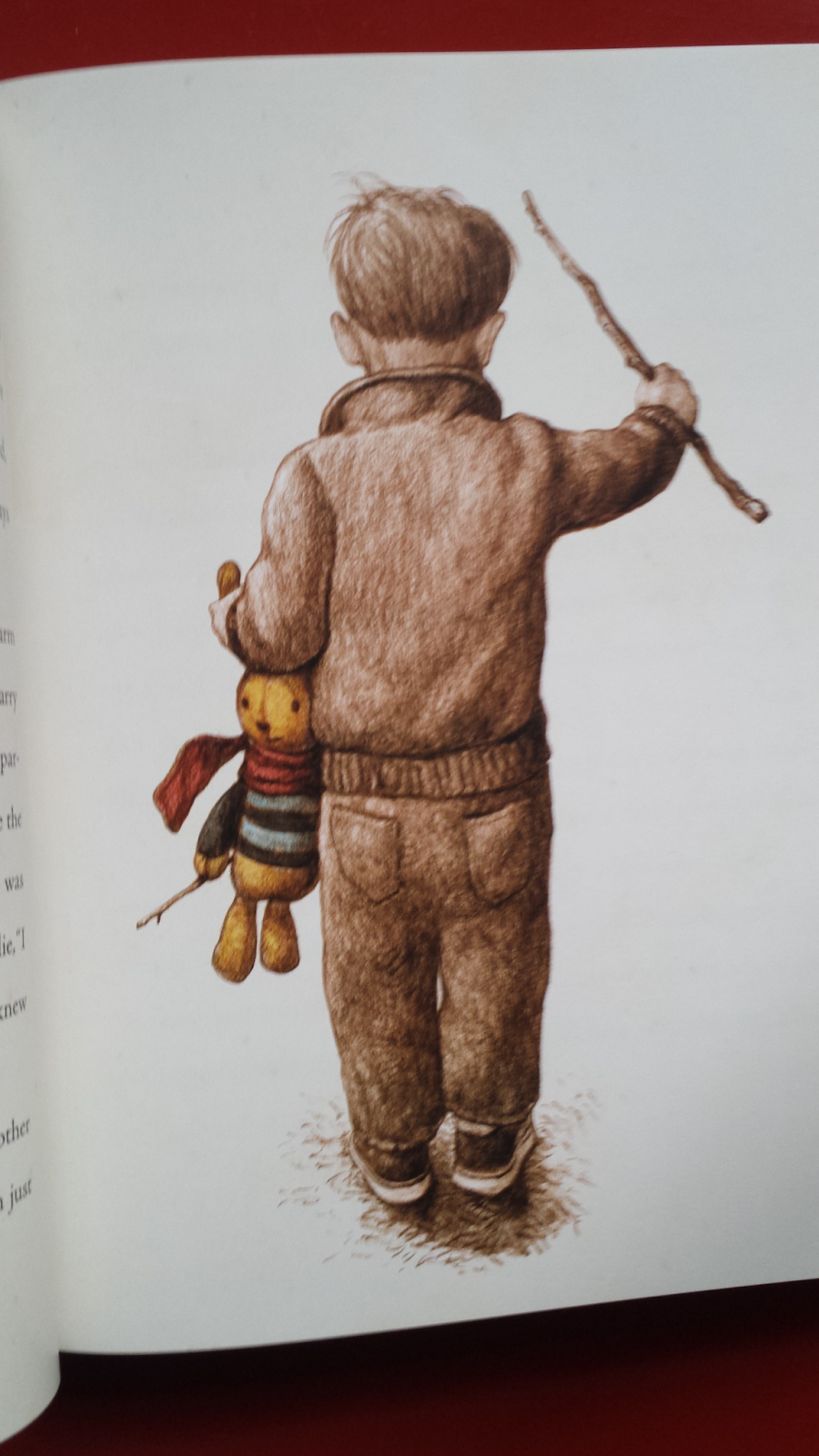
Ollie’s Odyssey is all about a kid named Billy and his special relationship with his toy, a ragdoll his mother made named Ollie.  During a wedding party, Ollie is kidnapped by the minions of an evil toy, the demented clown Zozo.  Billy must sneak out of his home at night and trace his lost friend, a journey that leads him to a deserted underground carnival, to a confrontation with a horde of menacing reconfigured toys, and to a final battle royale led by Ollie and some odds and ends who form a junk army.

In outline, it would seem as if Ollie’s Odyssey would be just another kid’s adventure story.  But Joyce uses this framework to write a deeply moving tale about growing up, the inevitability of change, loss and, perhaps most important, the power of memory.  Rather than a stock villain, Zozo has become twisted through the loss of his beloved ballet dancer-doll.  He is a tragic-villain, fully formed and compelling enough for the most adult fiction.  Similarly, Billy and Ollie fear changes to their friendship as Billy ages, and Ollie wonders what becomes of toys that are no longer loved.  The coming end for their partnership does not mitigate in any way the love they have for one another, but it does add a tragic dimension unusual for kiddie fare.  Joyce also talks about resurrection and rebirth during the junkyard sequence, where now useless bric-a-brac takes on new life and new identity to help Ollie and save Billy.  It is a stunning juggling act: Joyce has written a profoundly moving and emotionally resonant novel in the guise of a children’s book.

Just as Joyce has previously illustrated his picture books with dazzling watercolor work, and then branched out into both line drawings and computer illustration, Ollie’s Odyssey tests his versatility with a series of charcoal drawings – a medium he has not used in his published work before.  The illustrations of Ollie’s Odyssey are unlike those of any of Joyce’s previous work, and fit the overall emotional tenor of the story beautifully.  Charcoal brings a gritty, tactile sense to this tale of fuzzy friends and frayed castoffs that would be missing from glossier modes of illustration.  He also used the paper upon which he drew to great effect, allowing what would normally be the white ‘tooth’ of the paper to soak up computer-added color.  The book is also beautifully designed by Joyce with chapter heads in bold red crayon, and different colored papers representative of different characters and scenes. 


As with much of Joyce’s oeuvre, his latest book can be savored by adults as well as children. A man who loves popular art immoderately (and wears that love on his sleeve), Joyce peppers Ollie’s Odyssey with echoes of titans and works that come before.   Attuned readers will catch bits of filmmakers Todd Browning and Lon Chaney, hints of the classic Universal Monsters with a touch of The Island of Lost Souls, a healthy smattering of Ray Bradbury, and shout-outs to everything from the original King Kong to Batman Returns to The Magnificent Seven.  Indeed, the final image of the book is a direct rift on John Ford’s mighty ending for The Searchers … and one wonders if Joyce is writing for adults who have kept their inner child alive and well, or if he writes for children who will one day make more adult connections.

Ollie’s Odyssey is a bigger, grander, more ambitious book than anything that Joyce has attempted before, and he rises to the occasion splendidly.  It is certainly the finest of his prose novels, and one cannot but wonder what this protean talent has in store for us in future years.

While we are delighted that Joyce has spread his abilities into so many different areas, it is perhaps in books that devotees get the fullest distillation of his talents.  His written and illustrated works are the least collaborative of his output, and capture his philosophy best.  That view of life has been changing and evolving over time – that William Joyce names his protagonist Billy is surely no accident – and if the man himself can emerge from the crucible of experience with his sense of wonder intact, what is he not capable of?  And what, he asks, are any of us not capable of?  It’s that sense of possibility, that childlike sense of limitless adventure, that the world is filled with things to delight each and every one of us, that is the essence of Bill Joyce.


Ollie’s Odyssey is highly recommended to kids, old people, and everyone in between.