Showing posts with label Kenneth Grahame. Show all posts

Tuesday, November 22, 2016

Drawing of Kenneth Grahame by John Singer Sargent (1922)


Though it takes us by complete surprise, this week is Thanksgiving; and with that means the holidays are upon us, ready or not.

I wanted to start the season with something that resonated with the child within us all, without yet fully embracing the holidays.  Who better than Kenneth Grahame to meet the need?

We here at The Jade Sphinx think one of the greatest classics of English literature is a novel for serious children and frivolous adults, the magisterial Wind in the Willows (1908), by Kenneth Grahame (1859-1932).

Willows, like most of Grahame’s oeuvre, focuses around ideas of escape: Rat and Mole spend their boyish bachelorhood picnicking along the riverbank, simply “messing around in boats.”  His book the Pagan Papers (1893), is about the joyous sense of freedom he had in his youth (and, by comparison), the lack of such freedoms he had in adulthood.

This is not surprising considering Grahame’s tumultuous life.  He was born in Edinburgh, Scotland.  His mother died when he was five, and his alcoholic father gave young Kenneth and his brothers and sister to the children’s grandmother, in Cookham in Berkshire.  Grahame loved the countryside there, and it was there that he was introduced to the pleasures of boating.  These years in Cookham would be remembered as the happiest of his life.

Following his years at St. Edward’s School in Oxford, Grahame wanted to attend Oxford University.  He could not do so, his guardians claiming that it was too expensive.  Instead, this sensitive and introverted boy was sent to work at the Bank of England in 1879, where he rose through the ranks until retiring as its Secretary in 1908.  The reason for his retirement was that an anarchist broke into the bank and shot at Grahame three times, missing each shot.  The incident forever shattered his nerves; he would move back to the country in an effort to find peace.

Grahame published his first book, The Pagan Papers, in 1893.  He would follow this with his first two great novels about children, The Golden Age (1895) and Dream Days (1898).  He would not write again until after marrying Elspeth Thomson in 1899.  They had one child, a son named Alastair (nicknamed Mouse), born blind in one eye and plagued by various mental problems.  Grahame would tell Mouse stories about the woodland denizens around them.  These stories would eventually morph into Wind in the Willows.

Sadly, the stories provided only a limited amount of succor to Alastair, who would commit suicide by lying on a railway track two days before his 20th birthday.  The train would completely sever the boy’s head from his body, and Grahame was called to identify the remains.  The sight would haunt him for the rest of his life.

John Singer Sargent (1856-1925) was one of the greatest, and most prolific, of fin de siècle artists.  A gifted portraitist, Sargent was also painter of many magnificent landscapes, a champion draughtsman and watercolorist, and he also painted the mighty frescoes found in the Boston Public Library and the Museum of Fine Arts, Boston.

We will look at Sargent’s life in a little more detail tomorrow, but for now: after a lifetime of painting some of the finest portraits of his generation, Sargent painted less and drew more as he grew older.  He found drawing a release from painting; providing him with much the same sense of freedom Grahame had sought all his life. 

Sargent was able, with a stick of charcoal, to capture the essence of his sitter in a few hours (sometimes … a few minutes), relieving him of the burdensome process of multiple sittings and coloration. There are dozens of Sargent portrait drawings … and after the holidays, we’ll look at a few more.

But now, look at how Sargent masterfully captures Grahame.  Drawn in 1922, just two years after the suicide of Alistair, here is a man who was shot at in more ways than one.  His face has an austere quality, which is not surprising as he was reported to be emotionally distant … but what Sargent captures more than distance is disguise.   Grahame’s mouth is large and sensual, his chin strong and resolute.  But both of these features are hidden by an enormous walrus mustache; these were not uncommon in Edwardian men, but one feels that Sargent knew that the point was concealment and not fashion.  Half of Grahame’s face is in shadow, as if he would hide from us, if he could.

In terms of technique, it’s amazing what Sargent can accomplish with a few simple strokes.  His drawing is never fussy or overdone; the scattered quality of Grahame’s hair is suggested with some powerful strategic strokes, his shirt and jacket survive as just the barest outlines.  The planes of his face have been roughed-in with some hatching on the side of his charcoal, but the wonderful (and evocative!) lower lids of his eyes have been caught out with eraser. 

The entire picture is a little master’s class in quick portraiture, and it tells us a great deal about the genius behind The Wind in the Willows.  A sad and tragic man is here, revealed by Sargent’s incomparable skill.

Another Sargent drawing tomorrow!


Thursday, December 10, 2015

Through the Looking Glass: Further Adventures and Misadventures in the Realm of Children’s Literature, by Selma G. Lanes (2004)


Last week, we looked at Selma G. Lanes (1929-2009) and her initial book of collected essays and reviews, Down the Rabbit Hole, published in 1972.  This book was a significant watershed in serious criticism of the genre, and Your Correspondent recommends it highly.  More than 30 years later, Lanes returned with another collection of essays and reviews, Through the Looking Glass: Further Adventures and Misadventures in the Realm of Children’s Literature.  Does the latter book measure up to the former?

Actually, Lanes’ follow-up is not only worthy of its predecessor in every way, but in many instances quite superior.  Featuring essays and reviews written between the early 70s and 90s, Lanes continues to show a keen critical acumen and love for the subject.  Her voice is one that is greatly missed.
As would be expected from one of the first critical champions of Maurice Sendak (1928-2012) , Lanes writes about both his mid-and-late career triumphs with real sensitivity.  She also tackles the enigma that was Edward Gorey (1925-2000), a unique talent in children’s publishing in particular, and the art world in general.  Anyone familiar with Gorey’s spidery pen-and-ink drawings has a ‘take’ on him, but it was Lanes who described it best for me with the phrase “arctic detachment.”  She also argues, cogently, that Gorey was not a children’s illustrator at all, but rather a sometimes visitor to this realm.  Gorey’s sense of humor, his flights of fancy and his worldview were too mordant, too bizarre and too bleak for children, and many of his best books (The Gilded Bat comes to mind) are children’s books in name only.  Lanes summarizes his peculiar charm nicely.
Also excellent is Lanes’ chapter on the latter life of Beatrix Potter, who, once she was married and living in the Lake District she so dearly loved, turned away from her fabulous children’s books with nary a second thought.  Oddly enough, it was American collectors and publishers who kept the cult of Potter alive, and it is largely through their efforts that she is remembered today.  Kudos to Lanes for this bit of insight.
Useful, too, is her look at the letters of fairy tale master Hans Christian Andersen (1805-1875) and American writer, editor and publisher Horace Elisha Scudder (1838-1902), of Boston, Massachusetts.  Scudder, in letter after letter over the course of many years, slavishly worked to get authorized editions of Andersen’s books in the US; he also sent the Great Man many of his own stories and books.  Scudder, it seems, barely registered as a human being to the Great Man, who was too involved, too remote and too icy a character to respond in any human way.  All of Andersen’s heart, it seems went into his work, with nothing leftover for the man himself.
Lanes writes perceptively on the drawings of Ernest H. Shepard (1879-1976), who brought A.A. Milne’s Winnie-the-Pooh to graphic life, and was the ideal artist for Kenneth Grahame’s Wind in the Willows.  Shepard, it seems, understood whimsy (Milne) and English countryside philosophizing (Grahame), and was able to capture both with his pen.  Also valuable is Lanes’ chapter on New Yorker writer E. B. White (1899-1985), who also wrote the classics Charlotte’s Web and Stuart Little.  Lanes argues that his brevity, style and honesty were all reflections of his inner self; a man who finely hones his talents and his emotions until they were worthy of a public airing.  White is a type much missed in the contemporary world.
But Lanes’ best chapter, as in the previous book, is on the evils of the culture of Political Correctness and how it neuters literature and emotion, and how poisonous it is in particular to children’s literature.  On one hand, Lanes bemoans an atmosphere that seeks to find intolerance when there is none.  She is against expurgated versions of Dr. Doolittle, The Five Chinese Brothers, and the illustrated Yankee Doodle because she believes that children (a) are smart enough to understand historical context and (b) read for insights on character and not to underscore racial prejudices.  On the other hand, she also (rightly) abhors books that exist for no other reason than to make certain groups of people feel better about themselves.  As Lanes wisely put it: Now propaganda is an entirely legitimate and worthwhile endeavor when undertaken in a life-enhancing cause.  But those of us who choose books for children should be both willing and able to recognize the difference between propaganda and literature.
There is a great deal more in Lanes’ book (including insight on Winsor McCay, historian Roger Sale, and an excellent essay on Harry Potter written shortly before her death), and all of it smart, wise and very, very human.  Through the Looking Glass is still in print, and can be found at Books of Wonder in New York and online.  If you are even remotely interested in the subject, get it.


Wednesday, December 9, 2015

Walt Disney: The Triumph of the American Imagination, by Neal Gabler (2006)


As we approach Christmastime, many Americans will be looking to the films of Walt Disney (1901-1966) for holiday comfort.  Those interested in the man behind the brand could do not better than Neal Gabler’s magisterial biography, Walt Disney: The Triumph of the American Imagination.  It will leave you with the distinct impression of having met Disney himself, warts and all. 

Surely few American entertainment icons have been more discussed – or subject to more historical revision -- than Disney.  During his salad days of the 1920s and 30s, Disney was regarded as both an important artist (embraced by intellectuals and modernists like Dali), and an emerging American institution.  It was only with the national rupture of the 1960s that Disney’s reputation started to tarnish: books such as The Disney Version by Richard Schickel in 1968 sought to take down the Greatest Generation hero down as many pegs as possible.  (Indeed, Schickel’s attack is so out-of-proportion as to seem unhinged, sadly all too common in that both sad and common decade.)

The simple and irreducible fact is that Disney was neither the plaster saint of the right nor the uber-bogeyman of left, but rather a complicated and contradictory man who achieved remarkable things in animation, live-action filmmaking and that strange mix of theater and amusement park that is Disneyland.  Few American artists have had a more influential or pervasive grip on the American mindset (indeed, I cannot think of any), and fewer have transcended their own art to become a brand name.

In addition, there are few artists as resolutely American as Disney.  Raised on and near a farm in Marceline, Missouri to middle-class parents, Walt’s earliest surroundings were a mix of Tom Sawyer and The Music Man.  Though he would remember having a contentious relationship with his father (Walt always had a touch of self-dramatization), friends and neighbors remember him as perpetually sunny and optimistic.  He was fascinated by cartooning, by drawing, and by the possibilities of animated cartoons. 

After knocking around the nascent animation industry for a bit, Disney and his brother Roy (1893-1971) lit out for California in 1929 to hang their own shingle.  Many would think the rest is history, but not so, according to Gabler’s book, which chronicle the young animation entrepreneur’s struggle over the next decades, not fully finding financial success until well into the 1950s, despite great critical and popular success.

This sense of hand-to-mouth desperation is one of the many details found in this richly detailed book.  A dreamer and idea-man, Disney often drove innovation without regard to the costs, leaving money-man Roy with the problem of finding much-needed funds.  It seems that Disney took every success they had and funneled that money into some other plan, vision or scheme. 

Like many gifted creators of children’s entertainment – Kenneth Grahame (1859-1932) and L. Frank Baum (1856-1919) immediately come to mind – Disney was pulled in opposite poles by his idealized vision of home, safety and small-village charm on one side and by an overweening sense of travel, adventure and expansion on the other.  It seems that Walt never fully recovered from his happy years at Marceline, and sought new and innovative ways to recreate it.  (It is no surprise that Main Street in Disneyland – that tribute to small-town hominess – was modeled on Marceline.)  Walt longed to return to his own personal Arcadia, one foot in an idealized past and the other foot in an idealized future.  His studio, and later Disneyland, would be the engines he used to drive him back there.

The central argument of Gabler’s book is that Disney sought to create his own personal Neverland, an Arcadia where he could create in peace and play as he wanted.  Disney’s studio in the early years was an earthly paradise, with drawing lessons, endless fun-and-games and goofy good times, all with Walt watching paternalistically.  This haven was destroyed by a series of strikes that permanently marred Disney, pointing him towards increasingly rightwing or libertarian politics, while also making him more reclusive, autocratic and difficult to work with.

After the war and as he entered the 1950s, Walt seemed to lose interest in his empire, and spent a great deal of his time building man-sized model trains.  Though many thought he was losing his grip, actually Walt was retreating within himself as he conceptualized his next innovation: an actual, physical Wonderland that he could call home.  The creation of Disneyland was a balm to Walt, and he entered his second great phase of creativity – as filmmaker and innovator – once the project gained ground.

Soon after making Marry Poppins (1964), his last great film, and conceptualizing key components of the 1964 New York World’s Fair, Walt would be diagnosed with lung cancer and die, his studio and his name becoming a byword for family entertainment.  He also left behind a public persona – part real, part myth – that has attracted debunkers and back-biters for decades.

So, after so many years of pro-and-con debate, where does that leave Gabler’s readers?  There is a great deal of data to sift through in Gabler’s book – the research is exhaustive and the reporting sometimes exhausting.  (This is the type of biography where the author writes, “Walt walked the 90 feet to his office.”)  Gabler had unfettered access to Disney’s papers, and worked on the understanding that he would have complete autonomy over the final product.  Here, then, is the true Disney as he was, take him or leave him.

Disney was too slippery an entity for such classifications as hero or heel.  For example, he greatly wanted to create an Arcadia of sorts with his studio, but was also parsimonious with money, perks and control.  Gabler believes, and I agree, that he had no idea of the acrimony that would lead to such divisive strikes – strikes which cut Walt to the heart because they questioned his own inherent sense of decency.

To the charges that Disney vulgarized everything he touched, Gabler also chronicles the true artistic masterpieces for which he was responsible, including Snow White, Pinocchio, Bambi, and Fantasia.  The legacy of Disneyland is perhaps best summed up by the simple fact that a visit there has made countless millions of people happy.

A devoted husband and a doting and caring father, Disney could also be a shark in the realm of business, a credit hog, and a bully.  But Disney also faced hardships of a type that few readers of these words could ever imagine, and still managed to retain his innate optimism and come out sunnily on top.  He had grit and moxie, and, perhaps most of all, he had heart.  Bastard Saint, Everyman Bully, Uncle Hardcase – he was equal parts monster and sweetheart. 

Perhaps Disney managed to connect with America’s children in such a deep and profound way because Walt never completely grew up.  He was a paternalist who was still a kid.  The strike and financial hardship may have unfortunately politicized and soured him, but it never robbed him of his ability to dream. 

Neal Gabler’s book is a splendid chronicle of a complex and contradictory character; a uniquely American visionary of a type never to be seen again.  It is easy to see that, by the end of 800 pages, Gabler has become enamored of his subject, and Your Correspondent left the great man somewhat teary-eyed.  If you read only one book about Disney, make it Neal Gabler’s Walt Disney: The Triumph of the American Imagination.

Thursday, November 6, 2014

The Pagan Papers, by Kenneth Grahame (1893)


Regular visitors to The Jade Sphinx know of our love for children’s literature.  Few figures of the field loom larger than Kenneth Grahame (1859-1932), author of Wind in the Willows (1908), one of the great classics of the field.

Readers familiar with Wind know that it chronicles the adventures of Rat, Mole, Badger and Toad along the banks of the river.  Rat and Mole are often contentedly picnicking along the riverbank, simply “messing around in boats.”  Badger’s spacious underground abode provides comfort, books and plentiful food.  It is a perfectly sexless idealization of ease and creature comforts.

So it should come as no surprise that one of the recurring themes in Grahame’s oeuvre is that of escape.  Like many of the great children’s authors, Grahame had an ambivalent attitude towards adulthood and its concomitant responsibilities.

Poor Grahame had a tumultuous life.  He was born in Edinburgh, Scotland.  His mother died when he was five, and his alcoholic father gave young Kenneth and his brothers and sister to the children’s grandmother, in Cookham in Berkshire.  Grahame loved the countryside there, and it was there that he was introduced to the pleasures of boating.  These years in Cookham would be remembered as the happiest of his life.

Following his years at St. Edward’s School in Oxford, Grahame wanted to attend Oxford University.  He could not do so, his guardians claiming that it was too expensive.  Instead, this sensitive and introverted boy was sent to work at the Bank of England in 1879, where he rose through the ranks until retiring as its Secretary in 1908.  The reason for his retirement was that an anarchist broke into the bank and shot at Grahame three times, missing each shot.  The incident forever shattered his nerves; he would move back to the country in an effort to find peace.

Grahame published his first book, The Pagan Papers, in 1893.  He would follow this with his first two great novels about children, The Golden Age (1895) and Dream Days (1898).  He would not write again until after marrying Elspeth Thomson in 1899.  They had one child, a son named Alastair (nicknamed Mouse), born blind in one eye and plagued by various mental problems.  Grahame would tell Mouse stories about the woodland denizens around them.  These stories would eventually morph into Wind in the Willows.

Sadly, the stories provided only a limited amount of succor to Alastair, who would commit suicide by lying on a railway track two days before his 20th birthday.

The Pagan Papers is a collection of essays on the general theme of escape.  It has little (or nothing) to do with paganism as is understood today; actually, it was a long mediation on the invasive and horrifying transformations brought about by the machine age, and extolls the virtues of long country walks, rivers, the countryside, and welcoming pubs.

While the tone varies wildly from piece to piece, what is unmistakable is that the book is suffused with a powerful emotion, a particularly English yearning produced by the countryside.  Again and again Grahame urges pastoral escape, transgression against an increasingly urban system, and recognition of the genius of remote places, often represented in pagan figures like Pan.  That these essays were written by a man in the stranglehold of a formal job, distant from his beloved countryside, should come as no surprise.

This reader found many of the passages moving.  This is from his essay in favor of loafing and idleness:

When the golden Summer has rounded languidly to his close, when Autumn has been carried forth in russet winding-sheet, then all good fellows who look upon holidays as a chief end of life return from moor and stream and begin to take stock of gains and losses. And the wisest, realising that the time of action is over while that of reminiscence has begun, realise too that the one is pregnant with greater pleasures than the other — that action, indeed, is only the means to an end of reflection and appreciation. Wisest of all, the Loafer stands apart supreme. For he, of one mind with the philosopher as to the end, goes straight to it at once; and his happy summer has accordingly been spent in those subjective pleasures of the mind whereof the others, the men of muscle and peeled faces, are only just beginning to taste.

Here is another, in a more puckish vein: In these tame and tedious days of the policeman rampant, our melancholy selves are debarred from many a sport, joyous and debonair, whereof our happier fathers were free … 'Tis a sad but sober fact, that the most of men lead flat and virtuous lives, departing annually with their family to some flat and virtuous place, there to disport themselves in a manner that is decent, orderly, wholly uninteresting, vacant of every buxom stimulus. To such as these a suggestion, in all friendliness: why not try crime? We shall not attempt to specify the particular branch — for every one must himself seek out and find the path his nature best fits him to follow; but the general charm of the prospect must be evident to all. The freshness and novelty of secrecy, the artistic satisfaction in doing the act of self-expression as well as it can possibly be done; the experience of being not the hunter, but the hunted, not the sportsman, but the game; the delight of comparing and discussing crimes with your mates over a quiet pipe on your return to town; these new pleasures — these and their like — would furnish just that gentle stimulant, that peaceful sense of change so necessary to the tired worker.

My favorite passage, though, has to do with his friendship with a wandering painter – it is a view of freedom that resonates strongly with anyone in a restrictive job:  This allowed him to take along with him a few canvases and other artists' materials; soda-water, whisky, and such like necessaries; and even to ask a friend from town for a day or two, if he wanted to.

He was in this state of comparative luxury when at last, by the merest accident, I foregathered with him once more. I had pulled up to Streatley one afternoon, and, leaving my boat, had gone for a long ramble on the glorious North Berkshire Downs to stretch my legs before dinner. Somewhere over on Cuckhamsley Hill, by the side of the Ridgeway, remote from the habitable world, I found him, smoking his vesper pipe on the shaft of his cart, the mare cropping the short grass beside him. He greeted me without surprise or effusion, as if we had only parted yesterday, and without a hint of an allusion to past times, but drifted quietly into rambling talk of his last three years, and, without ever telling his story right out, left a strange picturesque impression of a nomadic life which struck one as separated by fifty years from modern conventional existence. The old road-life still lingered on in places, it seemed, once one got well away from the railway: there were two Englands existing together, the one fringing the great iron highways wherever they might go — the England under the eyes of most of us. The other, unguessed at by many, in whatever places were still vacant of shriek and rattle, drowsed on as of old: the England of heath and common and windy sheep down, of by-lanes and village-greens — the England of Parson Adams and Lavengro. The spell of the free untrammelled life came over me as I listened, till I was fain to accept of his hospitality and a horse-blanket for the night, oblivious of civilised comforts down at the Bull. On the downs where Alfred fought we lay and smoked, gazing up at the quiet stars that had shone on many a Dane lying stark and still a thousand years ago; and in the silence of the lone tract that enfolded us we seemed nearer to those old times than to these I had left that afternoon, in the now hushed and sleeping valley of the Thames.


This is a wise and wonderfully wistful book.  It is available at the indispensable Manybooks.net, and comes highly recommended.

Wednesday, October 22, 2014

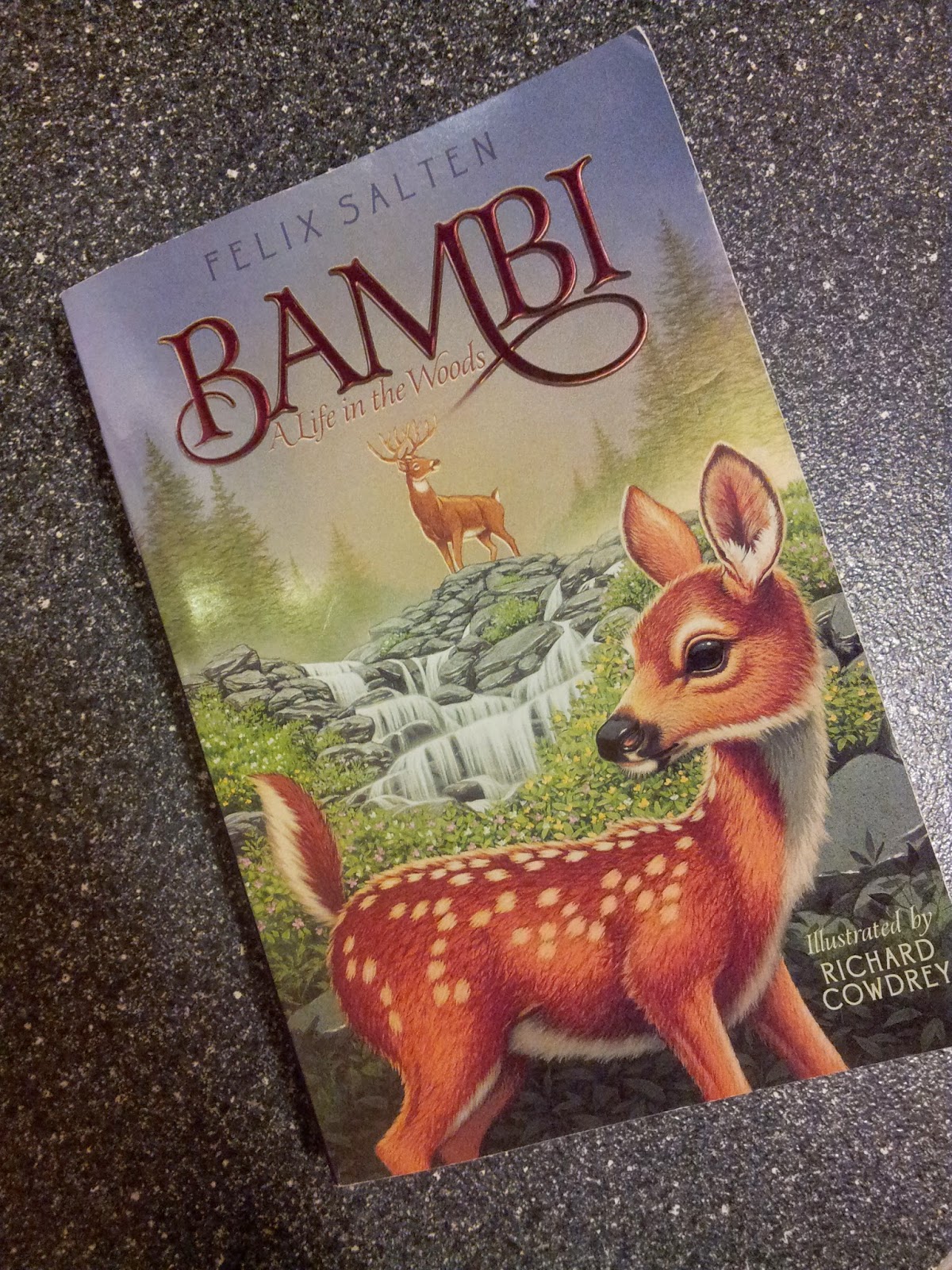
Bambi, A Life in the Woods, by Felix Salten

Every now and then, successful films make the novels upon which they were based superfluous.  Most everyone has seen some version or another of such classic novels as Pride and Prejudice or David Copperfield, but very few crack the original texts. 

When Walt Disney released Bambi in 1942, it seemed to erase all memory of its wonderful source-material, the novel Bambi, A Life in the Woods, written by Felix Salten (1869-1945) in 1923.  This is a great shame because in nearly every way imaginable, the novel is infinitely superior to the admittedly classic film.

The Disney film greatly softens the material, providing Bambi with amusing sidekicks and expanding the action with comic set-pieces.  Though there is an emotionally wrenching scene where Bambi’s mother is shot by hunters, it is not overall a somber or lachrymose film.  Indeed, it is one of the most limpid and lovely Disney films of the era.

This is very different from Salten’s novel (originally translated into English by Whittaker Chambers).  There, Bambi is born into a world of largely absent fathers, continual threat from hunters, fierce competition for food and resources, and the bitter reality of death. 

The lessons of Bambi are that life is often hard, and frequently entire populations become the sport of the casually cruel and powerful.  (As Salten himself would learn under the Nazis.)  Bambi particularly in his romantic maturation, often behaves badly himself, as if Salten is saying that we are born into a world where we are hardwired to be selfish and destructive.

While reading classic children’s novels, it is easy to think of their adult counterparts.  (For example, Kenneth Grahame’s The Wind in the Willows is the Jane Austin novel of the field).  The prose of Bambi, with all its simple, declarative force and echoes of an incantation, made me feel as if I were reading an anthropomorphic book of the Old Testament

It is also a remarkable meditation on mortality and loss.  While the film focuses on the death of Bambi’s mother, the novel’s most eloquent rumination on death comes between two leaves, anxiously discussing their upcoming fall.  Here’s a brief excerpt:

“Can it be true,” said the first leaf, “can it really be true, that others come to take our places when we’re gone and after them still others, and more and more?”

“It is really true,” whispered the second leaf. “We can’t’ even begin to imagine it, it’s beyond our powers.”

“It makes me very sad,” added the first leaf.

They were silent a while.  Then the first leaf said quietly to herself.  “Why must we fall?”

The second leaf asked, “What happens to us when we have fallen?”

“We sink down…”

“What is under us?”

The first leaf answered, “I don’t know, some say one thing, some another, but nobody knows.”

The second leaf asked, “Do we feel anything, do we know anything about ourselves when we’re down there?”

The first leaf answered, “Who knows?  Not one of all those down there has ever come back to tell us about it.”

Salten was a very prolific author, publishing about one book a year on average.  He is believed to be the anonymous author of the erotic novel Josephine Mutzenbacher (1906), which is about a Viennese prostitute.  Clearly a man of versatile literary achievements.

Like many Jewish artists, he fell into Hitler’s crosshairs; Der Fuhrer banned Salten’s books in 1936, and the author fled to Switzerland two years later.  He would die there.

Salter sold the film rights to Bambi to director Sidney Franklin for a mere $1,000; Franklin then sold the rights to Disney.  As is often the case with Disney and copyright, they would argue in the 1950s that the book was in the public domain and attempt to retain greater profits.  (Disney evocation of copyright always struck your correspondent as risible, considering they have made millions of dollars adapting public domain fairy tales.  Perhaps the scariest sequence of any Disney film happens in business meetings away from the camera.)

Adults who consider a “children’s novel” with trepidation should have no fear.  No less than John Galsworthy wrote that: Bambi is a delicious book.  Delicious not only for children but for those who are no longer so fortunate.  For delicacy of perception and essential truth I hardly know any story of animals that can stand beside this life study of a forest deer. 

We cannot argue.

Tomorrow -- the return of People’s Symphony Concerts!


Friday, January 17, 2014

Tolkien Will Never Be a Hobbit With Me


We here at the Jade Sphinx spent the Christmas holidays reading The Hobbit, written in 1937 by J. R. R. Tolkien (1892-1973).  It was the sole blot on a wonderful season.

I should state here that I have been reading – with great satisfaction and complicity – works of science fiction and fantasy for more than 40 years.  In my high school days (or, perhaps, daze), Tolkien’s Lord of the Rings trilogy was pressed into my hands by appreciative classmates, and I was never able to get beyond the mid-point of the second novel.  I have been allergic to hobbits, trolls, orcs and dwarves ever since.

As I reached my middle years, I have become more and more fascinated by the great works of children’s literature, books that I missed entirely during my actual growing up.  I did not read Wind in the Willows (1908) or Peter Pan (1911), or the Pooh or Oz books until well into adulthood.  Friends insisted that The Hobbit was a classic children’s novel, one of the most important of the 20th Century, and that I could not seriously say that I have read deeply in the field until I have digested this book.

My misgivings were exacerbated by the spate of recent truly awful film versions of Tolkien’s books.  I had an uncontrollable fit of the giggles during the first Lord of the Rings film (exploding into loud hilarity when I saw Christopher Lee and Ian McKellen beat up one-another), and the visuals of the films never quite gelled with the fleeting mental pictures I had made while trying to read the books.  I always think of hobbits as sort hominid rabbits, and seeing well-known actors in big-foot shoes and Mr. Spock ears does not quite gibe with my mental image.  We left the first film after the mid-way point, and kept our distance from all others until the recent first-film of The Hobbit series, and saw, with disappointment, that things never got any better.

But, on to the book.  The Hobbit deals with Bilbo Baggins, a member of a race of little people called hobbits, who travels away from his comfortable home in the company of dwarves to kill a dragon called Smaug and retrieve the treasure Smaug stole from the dwarves.  They are accompanied by a wizard, Gandalf, for the first and final halves of the journey – he is unaccountably absent from the hazardous middle-section.

At the end, dragon dead and dwarves reunited with gold, various groups of dwarves and elves and men, now in conflict over the treasure, band together to defeat a marauding band of goblins.  After much death and slaughter, Bilbo returns to his country home, a sadder but wiser hobbit.

In summary, it sounds like an interesting read, but the entire book is rendered a thudding bore by Tolkien’s lugubrious, turgid literary style.  Tolkien struggles to give his work the cadence of fairy tale or baldric epic, but succeeds only in creating faux-King-James-Bible or slightly rancid Kenneth-Grahame-knockoff. 

It is amazing that Tolkien, who made his career as a philologist as well as a professor of English Language and Literature, should have such a tin ear, but there it is.  Listening to The Hobbit read aloud (as I did to my better half during much of the holiday), is to experience a particularly donnish deconstruction of a tale created to excite into something quite bland and uninteresting.

The sections of The Hobbit that I enjoyed the most were those passages in the early part of the book where Bilbo Baggins is at home.  Hobbits, it seems, like good food (and lots of it), pipes and tobacco, a wee dram of something every now and then, warm homes and a life close to nature.  In short, all the best things found in Wind in the Willows and the Pooh books.  I actually love that part of the book … and certainly wish there was more of it.  (I dimly recall the opening birthday party scene of The Lord of the Rings, and hoping the books would get back on track with that – to no avail.)  As soon as the ‘adventure’ starts, my sympathy evaporates.  Tolkien obviously shared my sympathy for a pre-Industrial world, but the quest tale he creates for his ancient world invariably disappoints.

More telling, too, is that Tolkien often writes himself into a corner and then takes the easy way out.  Gandalf seems to have extremely limited powers for a wizard (he seems to be quite good with fireworks, and that’s about it), and the one time Gandalf can actually do some good, Tolkien absents him from the action while he is away on “other business.”  Worse yet, for a coming of age story, Bilbo uses his ring of invisibility much too often to keep himself out of any real danger; indeed, during the climactic battle, he spends most of his time literally invisible on the sidelines, keeping out of trouble.

Tolkien also drapes his cultural prejudices a little too thinly.  Clearly hobbits are the rural English, caught up in outer-world events not to their tastes and beyond their control.  The avaricious dwarves seem uncomfortably Jewish to this reader, and the wood elves a bit too much like gypsies.


Some wag at The New Yorker has called The Hobbit The Wind in the Willows Meets The Ring of the Nibelungen, and I can’t seem to top that.